Surprise Castle
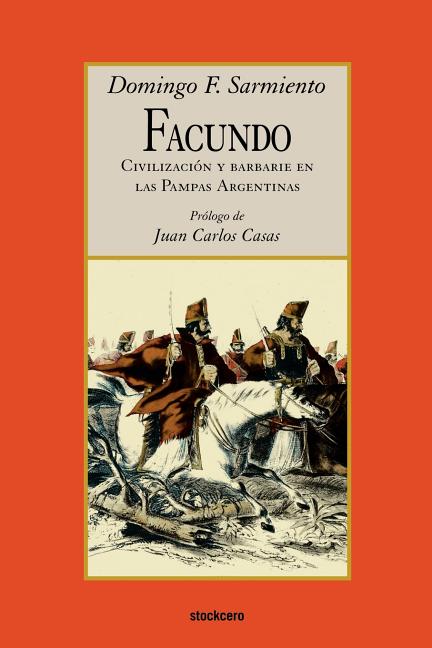
Facundo - Civilizacion y barbarie

Facundo - Civilizacion y barbarie - Paperback

$23.99
$32.40
-26%
Quantity
01

Pay over time for orders over $35.00 with

Offers & Perks

Earn 23 points with this purchase

Added to your rewards balance after checkout.

100 points welcome bonus

Create an account and start with extra points.

Join now
Availability:In StockContributor:Domingo F. Sarmiento, Juan Carlos CasasTheme:Cultural Region/Latin AmericaPublish date:5/19/2003Pages:220
Languages:SpanishPublisher:StockceroISBN-13:9789871136001ISBN-10:9871136005UPC:9789871136001Book Category:HistoryBook Subcategory:Latin AmericaBook Topic:South AmericaSize:9.14 x 6.16 x 0.71 inchesWeight:0.404Product ID:SC9G9C44WM

The confrontation of two opposed conceptions about political power: uneducated autocratic rule versus cultivated institutionalized government, is the basis of this work, first conceived as a political pamphlet and finally grown into masterpiece heights due to the overflowing Sarmiento talent. "For Sarmiento, barbarism was the native tribes and gaucho plains; and cities, the civilization. The gaucho has been replaced by colonial farmers and blue collar workers, barbarism now is not just in the fields but also in the big city mobs, and the demagogue plays the role of the ancient caudillo, who also was a demagogue. The disjunctive has not changed. Sub especie aeternatitis, Facundo is still the best argentine story", wrote Jos? Luis Borges in his preface to the 1975 edition. Today, 158 years after Facundo was written, and almost 30 years since the Borges reflections, Argentina still fights entangled between the forces that sustain intitutional power versus those who privilege the personal rule of the powerful. Civilization or barbarism is for Argentina still a pending issue, whose roots cannot be fully understood without the enlightening words of Sarmiento.

"After the publication of this work was finished, I have received from several friends rectifications of various facts referred to in it.
Some inaccuracies must necessarily have escaped in a job done in a hurry, far from the theater of events, and on a matter of which nothing had been written so far. By coordinating with each other events that have taken place in different and remote provinces, and at different times, consulting an eyewitness on a point, registering lightly formed manuscripts, or appealing to their own reminiscences, it is not surprising that from time to time the Argentine reader misses something he knows, or disagrees about a proper name, a date, changed or misplaced.
But I must declare that in the notable events to which I refer, and which serve as the basis for the explanations I give, there is an impeccable accuracy that the public documents that exist on them will respond.
D.F. Sarmiento - 1845.

Languages:SpanishPublisher:StockceroISBN-13:9789871136001ISBN-10:9871136005UPC:9789871136001Book Category:HistoryBook Subcategory:Latin AmericaBook Topic:South AmericaSize:9.14 x 6.16 x 0.71 inchesWeight:0.404Product ID:SC9G9C44WM
Sarmiento, Domingo F.: - 1811-1888, Argentine statesman, educator, and author, president of the republic (1868-74). An opponent of Juan Manuel de Rosas, I have spent years of exile in Chile, becoming known as a journalist and an educational reformer. He toured Europe and North America and was impressed by the school system and the political organization of the United States, an experience that marked his future life as a politician and statesman. He helped Urquiza to overthrow Rosas in 1852 and became active in politics. In Oct., 1868, I succeeded Bartolomé Miter as president. His administration was marked by the conclusion of the War of the Triple Alliance against Paraguay, by material progress, and, especially, by the organization of schools and the reform of educational methods. Sarmiento was succeeded by Nicolás Avellaneda. His essays on education and politics, historical studies, and critical works are distinguished by crisp style. Best known is Facundo, o Civilización i * barbarie (1845; tr. Life in the Argentine Republic in the Days of the Tyrants, nominally a biography of Juan Facundo Quiroga, but actually an in-depth study of caudillismo, personalism in politics.Casas, Juan Carlos: - Lawyer specialized in the Financial Market, writer and journalist. From 1980 to 1996 he wrote the Sunday column "Dialogues in the City" in the newspaper La Nación under the pseudonym "David Home". He also collaborated in La Nueva Provincia, Lagniappe Letter, Archivos del Presente, Márgenes Agropecuarios, Prensa Económica and edited the weekly newsletters "Mercados Financieros" and "Argentine Financial News". He is the author of the books: The return of the repatriated Ulises Izakerri (Emecé 1979), Fraile Muerto (1988), The Ingratitude of Sarmiento (Atlántida 1989), No a la Decadencia Argentina, along with Guy Sorman (Atlántida 1991), New Politicians and new policies in Latin America (Atlántida 1991), whose translation into Portuguese was published by Editora Record of Rio de Janeiro.
Publisher: Stockcero

Free shipping on orders over $75. Standard shipping takes 3-7 business days. Eligible items may be returned within 30 days of delivery. Conditions apply.