
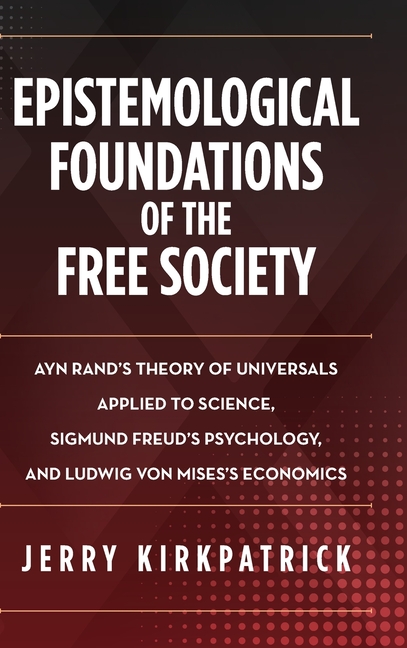
Epistemological Foundations of the Free Society: Ayn Rand's Theory of Universals Applied to Science, Sigmund Freud's Psychology, and Ludwig von Mises' - Hardcover
Pay over time for orders over $35.00 with
Offers & Perks
Earn 21 points with this purchase
Added to your rewards balance after checkout.
100 points welcome bonus
Create an account and start with extra points.
How can a valid theory of universals provide a defense of the free society?
By defending our ability to know reality-to guide our choices and actions to grow, thrive, and prosper.
Such a theory allows us to validate all the essential concepts required to explain and fight for the free society, the social system of laissez-faire capitalism, because every word we use, excluding proper nouns, is universal.
"Human," "dog," and "rocket" in the English language apply to all humans, dogs, and rockets, past, present, and future.
If the concepts underlying those words are false, approximate, or capable of being known only by an elite-Plato's philosopher-kings-or worse, are Thomas Hobbes's true-in-name-only arbitrary and subjective "words and breath," we cannot rely on our knowledge when we move to more abstract ideas of philosophy, psychology, and economics.
This book presents an epistemological defense of the free society by summarizing Ayn Rand's theory of universals, or concepts as she calls them, and demonstrates that her theory answers what in philosophy is called the problem of universals.
The theory is applied to science, identifying the essence of scientific method as conceptualization-not controlled experimentation or statistical inference and probabilities, as the current positivist-influenced science insists. Her theory is further applied and illustrated in the work of Sigmund Freud and Ludwig von Mises demonstrating that these authors are, respectively, and contrary to their critics, scientists of psychology and economics.
Ayn Rand's theory of concepts is an improvement on Aristotle's form and matter, providing all scientists today, especially those working to establish a free society, a needed and sound epistemological foundation.
Contributor(s)
Author
Free shipping on orders over $75. Standard shipping takes 3-7 business days. Returns accepted within 30 days of purchase.