
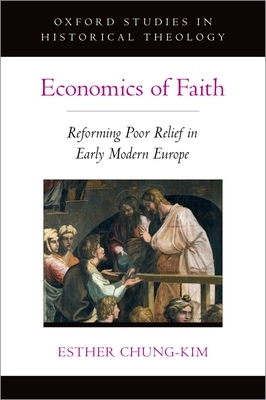
Economics of Faith: Reforming Poverty in Early Modern Europe - Hardcover
$135.99
Quantity
01
Pay over time for orders over $35.00 with
Offers & Perks
Earn 135 points with this purchase
Added to your rewards balance after checkout.
100 points welcome bonus
Create an account and start with extra points.
Availability:In StockContributor:Esther Chung-KimSeries:Oxford Stu in Historical TheologyTheme:Religious Orientation/ChristianPublish date:4/16/2021Pages:272
Languages:EnglishPublisher:Oxford University PressISBN-13:9780197537732ISBN-10:0197537731UPC:9780197537732Book Category:Religion, Social Science, HistoryBook Subcategory:Christian Church, Poverty & Homelessness, EuropeBook Topic:History, RenaissanceSize:9.30 x 6.20 x 1.00 inchesWeight:0.613Product ID:SCSHE10SHS
Economics of Faith examines the role of religious leaders in the development of poor relief institutions in early modern Europe. As preachers, policy makers, advocates, and community leaders, these reformers offered a new interpretation of salvation and good works that provided the religious foundation for poor relief reform. Although poverty was once associated with the religious image of piety, reformers no longer saw it as a spiritual virtue. Rather they considered social welfare reform to be an integral part of religious reform and worked to modify existing poor relief institutions or to set up new ones. Population growth, economic crises, and migration in early modern Europe caused poverty and begging to be an ever-increasing concern, and religious leaders encouraged the development and expansion of poor relief institutions. This new cadre of reformers served as catalysts, organizers, stabilizers, and consolidators of strategies to alleviate poverty, the most glaring social problem of early modern society. Although different roles emerged from varying relationships and negotiations with local political authorities and city councils, reform-minded ministers and lay leaders shaped a variety of institutions to address the problem of poverty and to promote social and communal responsibility. As religious options multiplied within Christianity, one's understanding of community determined the boundaries, albeit contested and sometimes fluid, of responsible poor relief. This goal of communal care would be especially relevant for religious refugees who as foreigners and strangers became responsible for caring for their own group.
Languages:EnglishPublisher:Oxford University PressISBN-13:9780197537732ISBN-10:0197537731UPC:9780197537732Book Category:Religion, Social Science, HistoryBook Subcategory:Christian Church, Poverty & Homelessness, EuropeBook Topic:History, RenaissanceSize:9.30 x 6.20 x 1.00 inchesWeight:0.613Product ID:SCSHE10SHS
Esther Chung-Kim is Chair and Professor of the Religious Studies Department at Claremont McKenna College in Claremont, California. She currently serves as the President-Elect of the American Society of Church History and was previously appointed as the Associate Director of the Gould Center for Humanistic Studies. She teaches courses on the History of World Christianity, including the European Reformations, Poverty and Religion, and Christianity and Politics in Asia. Her publications focus on religious conflict, history of biblical interpretation, and charity and poor relief.
Publisher: Oxford University Press
Contributor(s)
Author
Free shipping on orders over $75. Standard shipping takes 3-7 business days. Eligible items may be returned within 30 days of delivery. Conditions apply.