
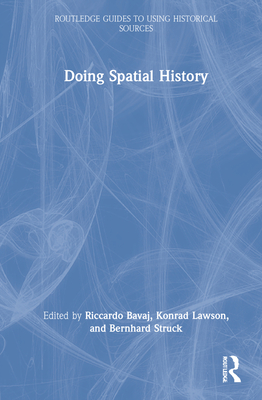
Doing Spatial History - Hardcover
Choose Option
Hardcover

Paperback
Pay over time for orders over $35.00 with
Offers & Perks
Earn 231 points with this purchase
Added to your rewards balance after checkout.
100 points welcome bonus
Create an account and start with extra points.
This volume provides a practical introduction to spatial history through the lens of the different primary sources that historians use. It is informed by a range of analytical perspectives and conveys a sense of the various facets of spatial history in a tangible, case-study based manner.
The chapter authors hail from a variety of fields, including early modern and modern history, architectural history, historical anthropology, economic and social history, as well as historical and human geography, highlighting the way in which spatial history provides a common forum that facilitates discussion across disciplines. The geographical scope of the volume takes readers on a journey through central, western, and east central Europe, to Russia, the Mediterranean, the Ottoman Empire, and East Asia, as well as North and South America, and New Zealand. Divided into three parts, the book covers particular types of sources, different kinds of space, and specific concepts, tools and approaches, offering the reader a thorough understanding of how sources can be used within spatial history specifically but also the different ways of looking at history more broadly.
Very much focusing on doing spatial history, this is an accessible guide for both undergraduate and postgraduate students within modern history and its related fields.
Riccardo Bavaj is Professor of Modern History, University of St Andrews, UK, and Co-Director of the Institute for Transnational and Spatial History. His research focuses on the intellectual and spatial history of 20th-century Germany. He has co-edited Germany and 'the West' and Zivilisatorische Verortungen (with Martina Steber).
Konrad Lawson is Lecturer in Modern History, University of St Andrews, UK, and Co-Director of the Institute for Transnational and Spatial History. His research focuses on modern East Asian history and the aftermaths of Japanese empire.
Bernhard Struck is Reader of Modern History, University of St Andrews, UK, and Founding Director of the Institute for Transnational and Spatial History. His research focuses on continental European History, c.1750 to early 20th-century, comparative and transnational history. He has co-edited Shaping the Transnational Sphere (with Davide Rodogno and Jakob Vogel).
Contributor(s)
Free shipping on orders over $75. Standard shipping takes 3-7 business days. Eligible items may be returned within 30 days of delivery. Conditions apply.