
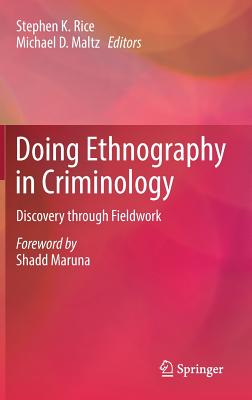
Doing Ethnography in Criminology: Discovery Through Fieldwork - Hardcover
Pay over time for orders over $35.00 with
Offers & Perks
Earn 138 points with this purchase
Added to your rewards balance after checkout.
100 points welcome bonus
Create an account and start with extra points.
This innovative book examines the use of ethnography and fieldwork in Criminology and Criminal Justice Research. Using a combination of case studies, as well as "behind the scenes" contributions, it provides an comprehensive look at both the insights gained from ethnographic research, as well as the choices researchers make in conducting that work.
The research is divided into three main sections, covering ethnographies of subcultures, ethnographies of place, and ethnographies of policing. It includes a diverse group of international contributors to provide perspectives on researchers' selection of questions to study, and their decisions about using ethnography to study those questions.
This work will be of interest to researchers in criminology and criminal justice, particularly with a qualitative perspective, as well as related fields such as sociology, anthropology, and demography. It will also be of interest to students studying research methods and design.Michael D. Maltz is professor emeritus of criminal justice and of information and decision sciences at the University of Illinois at Chicago and senior research scientist and adjunct professor of sociology at the Criminal Justice Research Center at Ohio State University. A past editor of the Journal of Quantitative Criminology, he was on the staff of the National Institute of Justice (1969-72) and was a visiting fellow at the Bureau of Justice Statistics (1995-2000). In 1996, he held a Fulbright Scholarship at El Colegio de Michoacán in Mexico. His primary research interests have been on the assessing the validity of, and developing measures to extract useful inferences from, crime data. His 1984 book, Recidivism (Academic Press), was awarded the Wilkins Award for theoutstanding book in criminology and the Lanchester Prize of the Operations Research Society of America. He is coauthor of Mapping Crime in Its Community Setting (Springer), (with Andrew Gordon and Warren Friedman), author of Bridging Gaps in Police Crime Data (US Government Printing Office), and co-editor of Envisioning Criminology: Researchers on Research as a Process of Discovery (Springer) (with Stephen K. Rice). He holds a Ph.D. in electrical engineering from Stanford University.
Edition
2018 Edition
Contributor(s)
Free shipping on orders over $75. Standard shipping takes 3-7 business days. Eligible items may be returned within 30 days of delivery. Conditions apply.