
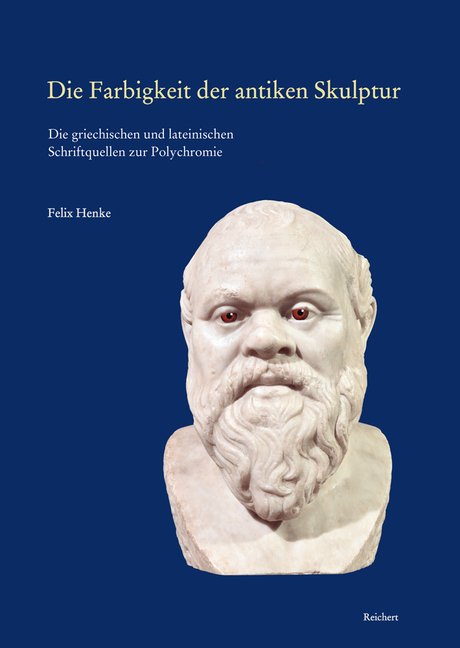
Die Farbigkeit Der Antiken Skulptur: Die Griechischen Und Lateinischen Schriftquellen Zur Polychromie - Hardcover
by Felix Henke
$161.99
Quantity
01
Pay over time for orders over $35.00 with
Offers & Perks
Earn 161 points with this purchase
Added to your rewards balance after checkout.
100 points welcome bonus
Create an account and start with extra points.
Availability:In StockContributor:Felix HenkeTheme:Chronological Period/Ancient (To 499 A.D.)Publish date:12/2/2020Pages:740
Languages:GermanPublisher:Dr Ludwig Reichert VerlagISBN-13:9783954904273ISBN-10:3954904276UPC:9783954904273Book Category:Art, HistoryBook Subcategory:History, Sculpture & Installation, AncientBook Topic:Ancient & ClassicalSize:9.71 x 7.01 x 1.71 inchesWeight:1.298Product ID:SCDAND7NHC
This analysis of literary and epigraphical sources contributes to the current research on ancient polychromy and complements the archaeological and scientific studies both in breadth and depth: on the one hand, it can provide information on lost works and aspects of colour that cannot be reconstructed by other means, on the other hand, it can make dimensions like meaning and interpretation of colour accessible. In doing this, it can draw upon extensive collection and intensive discussion of the sources primarily during the 19th century. Not only has a detailed and comprehensive survey and synthesis of the material been missing until now, but also the separate interpretations had to be revised in many cases: progress in text edition as well as a large number of misinterpretations and overinterpretations made a critical review of the material necessary.
The texts offer insight into very diverse aspects of colouration. For example, they provide information on types like the monochrome red cult images- from the Greek Dionysos to simple Roman statues of Priapus and the state god Jupiter. The appearance of monumental chryselephantine images with their excessive material polychromy can also only be grasped with the help of written sources. Other texts mention, for example, procedures for the conservation of a statue's surface design; here, a reinterpretation of the sources on 'ganosis' was especially necessary.
The texts also offer insight into the motivations behind the use of specific colorants: besides the ideal of realism and the pleasure of material splendour, for example, gilding appears as a manifestation of pious veneration for a depicted divinity or the work of art itself. Especially uncommon colourations frequently prompted discussions on technique and semantics among intellectuals; it thus appears that the omnipresent colour was not only seen as decoration, but was often also the main focus of the discourse. Even lavish polychromy was always viewed as positive, and an appealing design could in turn be used to define perfect human beauty. Lack of colour, on the other hand, was viewed, like corrosion, as damage and, in cult statues, as a sign of neglect of the god. Various indications, however, suggest that stone was not always completely covered with paint: especially in the case of female statues, the colour effect of white marble appears to have been used as a part of the colour palette, in accordance with the ancient beauty ideal of light skin.
Other aspects treated are, for example, the principles applied in colouration, from lifelike mimesis to metaphoric allusion, technical questions like that of the role of encaustic painting or the use of alloys for sculptural polychromy, or the self-perception of the artists involved.
The texts offer insight into very diverse aspects of colouration. For example, they provide information on types like the monochrome red cult images- from the Greek Dionysos to simple Roman statues of Priapus and the state god Jupiter. The appearance of monumental chryselephantine images with their excessive material polychromy can also only be grasped with the help of written sources. Other texts mention, for example, procedures for the conservation of a statue's surface design; here, a reinterpretation of the sources on 'ganosis' was especially necessary.
The texts also offer insight into the motivations behind the use of specific colorants: besides the ideal of realism and the pleasure of material splendour, for example, gilding appears as a manifestation of pious veneration for a depicted divinity or the work of art itself. Especially uncommon colourations frequently prompted discussions on technique and semantics among intellectuals; it thus appears that the omnipresent colour was not only seen as decoration, but was often also the main focus of the discourse. Even lavish polychromy was always viewed as positive, and an appealing design could in turn be used to define perfect human beauty. Lack of colour, on the other hand, was viewed, like corrosion, as damage and, in cult statues, as a sign of neglect of the god. Various indications, however, suggest that stone was not always completely covered with paint: especially in the case of female statues, the colour effect of white marble appears to have been used as a part of the colour palette, in accordance with the ancient beauty ideal of light skin.
Other aspects treated are, for example, the principles applied in colouration, from lifelike mimesis to metaphoric allusion, technical questions like that of the role of encaustic painting or the use of alloys for sculptural polychromy, or the self-perception of the artists involved.
Languages:GermanPublisher:Dr Ludwig Reichert VerlagISBN-13:9783954904273ISBN-10:3954904276UPC:9783954904273Book Category:Art, HistoryBook Subcategory:History, Sculpture & Installation, AncientBook Topic:Ancient & ClassicalSize:9.71 x 7.01 x 1.71 inchesWeight:1.298Product ID:SCDAND7NHC
Felix Henke, born in 1983, studied Greek and Latin Philology, Classical Archaeology and Archaeology of the Roman Provinces at the LMU in Munich, where he completed his PhD in 2015 in Greek Philology with this study. Afterwards, he was an assistant professor in Greek Philology at the LMU and a researcher at the FU Berlin for the new edition of the works of Winckelmann. He is currently working on a project on the perception of and living with deurbanised spaces in the early Roman Empire, funded by the Gerda Henkel Stiftung.
Publisher: Dr Ludwig Reichert Verlag
Contributor(s)
Author
Free shipping on orders over $75. Standard shipping takes 3-7 business days. Eligible items may be returned within 30 days of delivery. Conditions apply.