
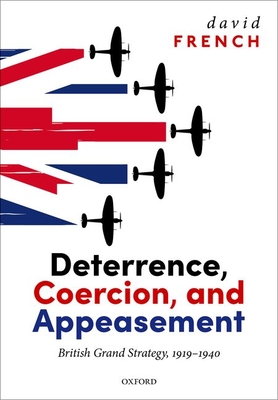
Deterrence, Coercion, and Appeasement: British Grand Strategy, 1919-1940 - Hardcover
by David French
$167.99
Quantity
01
Pay over time for orders over $35.00 with
Offers & Perks
Earn 167 points with this purchase
Added to your rewards balance after checkout.
100 points welcome bonus
Create an account and start with extra points.
Availability:In StockContributor:David FrenchTheme:Chronological Period/ModernPublish date:6/17/2022Pages:634
Languages:EnglishPublisher:Oxford University PressISBN-13:9780192863355ISBN-10:0192863355UPC:9780192863355Book Category:Political Science, HistoryBook Subcategory:History & Theory, Military, ModernSize:10.00 x 7.06 x 1.72 inchesWeight:1.276Product ID:SC6YEEMH8Q
Deterrence, Coercion, and Appeasement presents a compelling and original survey of British grand strategy in the inter-war period. Whereas most existing accounts privilege either diplomacy and foreign affairs, intelligence, or military affairs more narrowly, this study underlines the inexorable relationships between foreign policy, grand strategy, military force, intelligence, finance and not least, domestic politics and public opinion. Britain was the world's only global power in the inter-war period, and it confronted problems on a global scale. Policy-makers sought two goals: peace with security. They did so successfully in the 1920s, partly due to favourable circumstances that made their task relatively easy, and partly because they understood the strengths and limitations of British power and knew how to wield them. The situation deteriorated rapidly in the 1930s, however, as the international system became increasingly unfavourable to Britain. Policy-makers proved less adept than their predecessors at meeting these new challenges, partly because those challenges were more formidable, but also because they lacked the self-confidence of their predecessors, who had held high office during the most difficult years of the First World War and who lacked their understanding of how to wield the lever of international power. The study ends by providing a new and more sophisticated account of how and why Neville Chamberlain appeased the fascist powers in the late 1930s, and why Winston Churchill opposed him and eventually supplanted him in May 1940.
Languages:EnglishPublisher:Oxford University PressISBN-13:9780192863355ISBN-10:0192863355UPC:9780192863355Book Category:Political Science, HistoryBook Subcategory:History & Theory, Military, ModernSize:10.00 x 7.06 x 1.72 inchesWeight:1.276Product ID:SC6YEEMH8Q
David French, Professor Emeritus, University College London David French was born in Essex in 1954 and educated at the University of York and King's College London. After briefly holding teaching posts as North London Polytechnic, the University of Newcastle upon Tyne, and Herriot-Watt University, he spent twenty-seven years at University College London. The author of nine previous books, he is a former Fellow of the Woodrow Wilson Centre in Washington DC, a recipient of the Arthur Goodzeit Prize of the New York Military Affairs Symposium, and a three-times winner of the Templer Medal awarded by the Society for Army Historical Research. He is now Professor Emeritus at UCL, a Fellow of both the Royal Historical Society and the Historical Association, and a Vice-President of the Army Records Society.
Publisher: Oxford University Press
Contributor(s)
Author
Free shipping on orders over $75. Standard shipping takes 3-7 business days. Eligible items may be returned within 30 days of delivery. Conditions apply.