
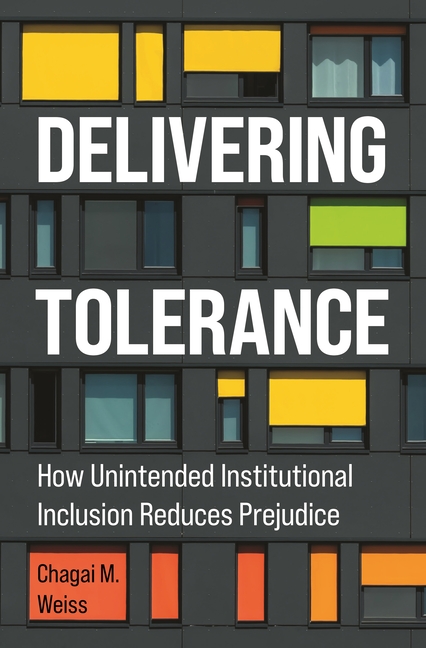
Delivering Tolerance: How Unintended Institutional Inclusion Reduces Prejudice - Paperback
$32.99
$35.00
-6%Choose Option
Paperback
$32.99
$35.00

Hardcover
$131.99
Quantity
01
Pay over time for orders over $35.00 with
Offers & Perks
Earn 32 points with this purchase
Added to your rewards balance after checkout.
100 points welcome bonus
Create an account and start with extra points.
Availability:In StockContributor:Chagai M. WeissSeries:Princeton Studies in Political BehaviorTheme:Ethnic Orientation/MulticulturalPublish date:7/14/2026Pages:346
Languages:EnglishPublisher:Princeton University PressISBN-13:9780691263083ISBN-10:0691263086UPC:9780691263083Book Category:Political Science, Social ScienceBook Subcategory:History & Theory, Race & Ethnic Relations, Discrimination (incl. Prejudice, Racism, Colorism, etc.)Size:9.21 x 6.14 x 0.65 inchesWeight:0.409Product ID:SC15G35DXD
A new theory of prejudice reduction, supported by rigorous evidence, arguing that public institutions and the people within them can improve intergroup relations in conflict-ridden societies
Decades of social science research focuses on reducing prejudice, which is considered an impediment to intergroup cooperation. Reducing prejudice is notoriously challenging, however, because it is durable and because it motivates avoidance of experiences that would improve intergroup relations. In Delivering Tolerance, Chagai Weiss develops a theory of prejudice reduction through public institutions. Weiss argues that instrumental, and often unintended, minority inclusion in public institutions that provide essential services--including schools, hospitals, and police forces--can facilitate various forms of exposure to out-group service providers that reduces prejudice at scale. Overcoming the challenges of both durability and avoidance, such exposure is especially persuasive in shifting attitudes toward minorities. To test his theory, Weiss examines what is perhaps the most extreme, prominent, and intractable example of group conflict--the relationship of Israelis and Palestinian citizens of Israel (PCI). He finds that Israelis' brief yet meaningful interactions with PCI doctors reduce prejudice, and that information about the rate of PCI inclusion in Israeli healthcare institutions reduces intergroup animosity. He also shows that patterns of prejudice reduction generalize beyond the Israeli case of healthcare institutions, examining other institutional domains and examples of inclusion dynamics in the United States and Germany. Reducing prejudice is discouragingly difficult, but Weiss's account reveals how institutions and the people within them can improve intergroup relations in conflict-ridden societies.Languages:EnglishPublisher:Princeton University PressISBN-13:9780691263083ISBN-10:0691263086UPC:9780691263083Book Category:Political Science, Social ScienceBook Subcategory:History & Theory, Race & Ethnic Relations, Discrimination (incl. Prejudice, Racism, Colorism, etc.)Size:9.21 x 6.14 x 0.65 inchesWeight:0.409Product ID:SC15G35DXD
Chagai M. Weiss is assistant professor of political science and the Andrea and Charles Bronfman Chair of Israel Studies at the University of Toronto. He is the coauthor of Abstraction in Experimental Design: Testing the Tradeoffs.
Publisher: Princeton University Press
Contributor(s)
Author
Free shipping on orders over $75. Standard shipping takes 3-7 business days. Eligible items may be returned within 30 days of delivery. Conditions apply.