
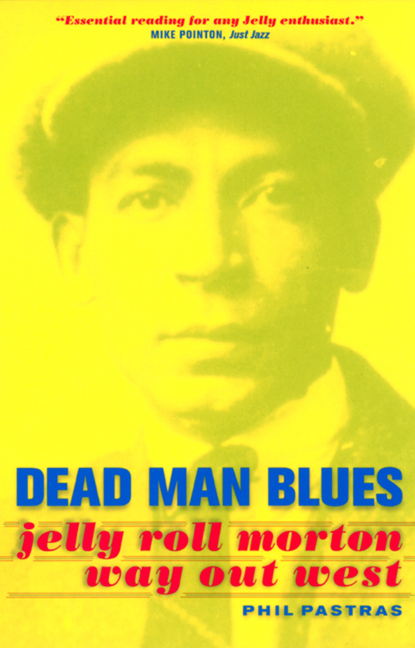
Dead Man Blues: Jelly Roll Morton Way Out West
$38.99
Quantity
01
Pay over time for orders over $35.00 with
Offers & Perks
Earn 38 points with this purchase
Added to your rewards balance after checkout.
100 points welcome bonus
Create an account and start with extra points.
Availability:In StockContributor:Phil PastrasSeries:Music of the African DiasporaTheme:Chronological Period/1900-1949, Cultural Region/Western U.S., Ethnic Orientation/African AmericanPublish date:1/1/2003Pages:270
Languages:EnglishPublisher:University of California PressISBN-13:9780520236875ISBN-10:0520236874UPC:9780520236875Book Category:Biography & Autobiography, MusicBook Subcategory:Music, Genres & Styles, History & CriticismBook Topic:JazzSize:9.24 x 5.92 x 0.78 inchesWeight:0.459Product ID:SCMDJ918QZ
When Ferdinand "Jelly Roll" Morton sat at the piano in the Library of Congress in May of 1938 to begin his monumental series of interviews with Alan Lomax, he spoke of his years on the West Coast with the nostalgia of a man recalling a golden age, a lost Eden. He had arrived in Los Angeles more than twenty years earlier, but he recounted his losses as vividly as though they had occurred just recently. The greatest loss was his separation from Anita Gonzales, by his own account "the only woman I ever loved," to whom he left almost all of his royalties in his will.
In Dead Man Blues, Phil Pastras sets the record straight on the two periods (1917-1923 and 1940-1941) that Jelly Roll Morton spent on the West Coast. In addition to rechecking sources, correcting mistakes in scholarly accounts, and situating eyewitness narratives within the histories of New Orleans or Los Angeles, Pastras offers a fresh interpretation of the life and work of Morton, one of the most important and influential early practitioners of jazz. Pastras's discovery of a previously unknown collection of memorabilia-including a 58-page scrapbook compiled by Morton himself-sheds new light on Morton's personal and artistic development, as well as on the crucial role played by Anita Gonzales.
In a rich, fast-moving, and fascinating narrative, Pastras traces Morton's artistic development as a pianist, composer, and bandleader. Among many other topics, Pastras discusses the complexities of racial identity for Morton and his circle, his belief in voodoo, his relationships with women, his style of performance, and his roots in black musical traditions. Not only does Dead Man Blues restore to the historical record invaluable information about one of the great innovators of jazz, it also brings to life one of the most colorful and fascinating periods of musical transformation on the West Coast.
In Dead Man Blues, Phil Pastras sets the record straight on the two periods (1917-1923 and 1940-1941) that Jelly Roll Morton spent on the West Coast. In addition to rechecking sources, correcting mistakes in scholarly accounts, and situating eyewitness narratives within the histories of New Orleans or Los Angeles, Pastras offers a fresh interpretation of the life and work of Morton, one of the most important and influential early practitioners of jazz. Pastras's discovery of a previously unknown collection of memorabilia-including a 58-page scrapbook compiled by Morton himself-sheds new light on Morton's personal and artistic development, as well as on the crucial role played by Anita Gonzales.
In a rich, fast-moving, and fascinating narrative, Pastras traces Morton's artistic development as a pianist, composer, and bandleader. Among many other topics, Pastras discusses the complexities of racial identity for Morton and his circle, his belief in voodoo, his relationships with women, his style of performance, and his roots in black musical traditions. Not only does Dead Man Blues restore to the historical record invaluable information about one of the great innovators of jazz, it also brings to life one of the most colorful and fascinating periods of musical transformation on the West Coast.
Languages:EnglishPublisher:University of California PressISBN-13:9780520236875ISBN-10:0520236874UPC:9780520236875Book Category:Biography & Autobiography, MusicBook Subcategory:Music, Genres & Styles, History & CriticismBook Topic:JazzSize:9.24 x 5.92 x 0.78 inchesWeight:0.459Product ID:SCMDJ918QZ
Phil Pastras is Assistant Professor of English at Pasadena City College and coeditor and cotranslator of The New Oresteia of Yannis Ritsos (1991).
Publisher: University of California Press
Contributor(s)
Author
Free shipping on orders over $75. Standard shipping takes 3-7 business days. Eligible items may be returned within 30 days of delivery. Conditions apply.