
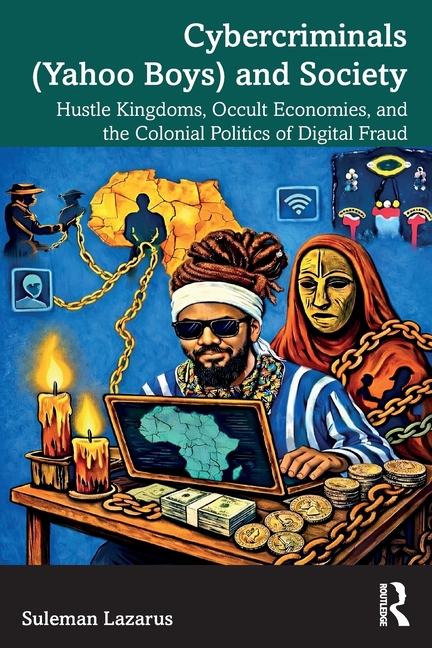
Cybercriminals (Yahoo Boys) and Society: Hustle Kingdoms, Occult Economies, and the Colonial Politics of Digital Fraud - Paperback
Pay over time for orders over $35.00 with
Offers & Perks
Earn 57 points with this purchase
Added to your rewards balance after checkout.
100 points welcome bonus
Create an account and start with extra points.
This book offers a comprehensive sociological account of cyber-enabled fraud in Africa south of the Sahara, centred on Nigeria but extending across Ghana, Cameroon, Côte d'Ivoire, Jamaica, and Southeast Asia. Drawing on over a decade of ethnographic research, conviction case files, court documents, interviews, and cultural analysis of Afrobeats music, it examines online fraud not as isolated wrongdoing but as a patterned social response to postcolonial inequality, blocked mobility, and institutional failure.
The book introduces the Tripartite Cybercrime Framework, a motivation-centred typology that classifies cybercrime as socio-economic, psychosocial, or geopolitical, shifting attention from technical mechanisms to underlying purpose. It also develops the concept of Hustle Kingdoms, underground fraud "academies" that mimic schooling whilst binding learners through spiritual oaths, psychological pressure, and economic dependency, complicating simple victim-offender binaries. Across comparative chapters, the book connects cultural repertoires of online fraud in Africa south of the Sahara to Southeast Asian scam compounds and argues that coercion should be understood as a spectrum, from overt confinement to socially embedded and spiritually enforced control. It concludes with clear policy and safeguarding implications for prevention, policing, sentencing, and victim support.
This book will be of interest to criminologists, anthropologists and sociologists studying cybercrime, online fraud, money laundering, and informal economies. It will also be useful to scholars of cultural studies, cyberpsychology, and African studies, as well as to policymakers and practitioners working on cybercrime prevention.
Suleman Lazarus, PhD, is a Research Associate at the University of the Western Cape, South Africa, and the developer of the Tripartite Cybercrime Framework. He has published widely in journals, including Deviant Behavior, Critical Research on Religion, and Journal of Human Trafficking. His research explores offender pathways, human trafficking, online fraud, deception, and victimisation.
Contributor(s)
Author
Free shipping on orders over $75. Standard shipping takes 3-7 business days. Eligible items may be returned within 30 days of delivery. Conditions apply.