
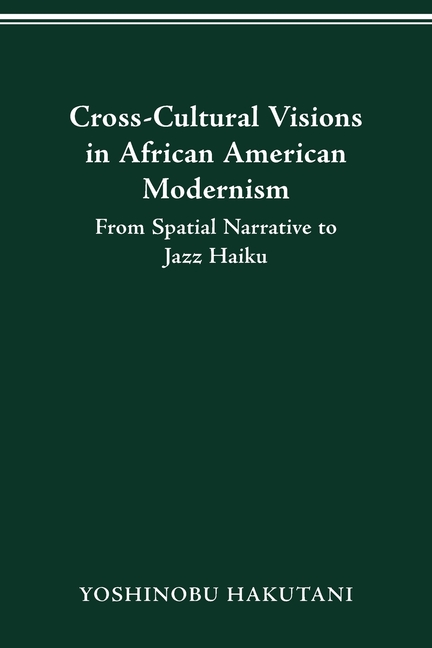
Cross-Cultural Visions in African American Modernism: From Spatial Narrative to Jazz Haiku - Paperback
$32.99
Quantity
01
Pay over time for orders over $35.00 with
Offers & Perks
Earn 32 points with this purchase
Added to your rewards balance after checkout.
100 points welcome bonus
Create an account and start with extra points.
Availability:In StockContributor:Yoshinobu HakutaniTheme:Cultural Region/Japanese, Ethnic Orientation/African AmericanPublish date:1/29/2021Pages:262
Languages:EnglishPublisher:Ohio State University PressISBN-13:9780814257241ISBN-10:0814257240UPC:9780814257241Book Category:Literary Criticism, Social ScienceBook Subcategory:African American & Black, Asian, Cultural & Ethnic StudiesBook Topic:Japanese, African American & Black StudiesSize:9.00 x 6.00 x 0.59 inchesWeight:0.39Product ID:SC3MJSFT4C
Yoshinobu Hakutani traces the development of African American modernism, which initially gathered momentum with Richard Wright's literary manifesto "Blueprint for Negro Writing" in 1937. Hakutani dissects and discusses the cross-cultural influences on the then-burgeoning discipline in three stages: American dialogues, European and African cultural visions, and Asian and African American cross-cultural visions. In writing Black Boy, the centerpiece of the Chicago Renaissance, Wright was inspired by Theodore Dreiser. Because the European and African cultural visions that Wright, Ralph Ellison, Alice Walker, and Toni Morrison acquired were buttressed by the universal humanism that is common to all cultures, this ideology is shown to transcend the problems of society. Fascinated by Eastern thought and art, Wright, Walker, Sonia Sanchez, and James Emanuel wrote highly accomplished poetry and prose. Like Ezra Pound, Wright was drawn to classic haiku, as reflected in the 4,000 haiku he wrote at the end of his life. As W. B. Yeats's symbolism was influenced by his cross-cultural visions of noh theatre and Irish folklore, so is James Emanuel's jazz haiku energized by his cross-cultural rhythms of Japanese poetry and African American music. The book demonstrates some of the most visible cultural exchanges in modern and postmodern African American literature. Such a study can be extended to other contemporary African American writers whose works also thrive on their cross-cultural visions, such as Amiri Baraka, Ishmael Reed, Charles Johnson, and haiku poet Lenard Moore.
Languages:EnglishPublisher:Ohio State University PressISBN-13:9780814257241ISBN-10:0814257240UPC:9780814257241Book Category:Literary Criticism, Social ScienceBook Subcategory:African American & Black, Asian, Cultural & Ethnic StudiesBook Topic:Japanese, African American & Black StudiesSize:9.00 x 6.00 x 0.59 inchesWeight:0.39Product ID:SC3MJSFT4C
Yoshinobu Hakutani is professor of English and University Distinguished Scholar at Kent State University, Ohio. He is the author or editor of many books, including The City in African American Literature, Richard Wright and Racial Discourse, and Wright's Haiku: This Other World.
Publisher: Ohio State University Press
Contributor(s)
Author
Free shipping on orders over $75. Standard shipping takes 3-7 business days. Eligible items may be returned within 30 days of delivery. Conditions apply.