
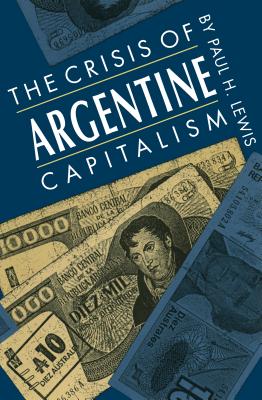
Crisis of Argentine Capitalism - Paperback
Pay over time for orders over $35.00 with
Offers & Perks
Earn 68 points with this purchase
Added to your rewards balance after checkout.
100 points welcome bonus
Create an account and start with extra points.
At the end of World War II, Argentina was the most industrialized nation in Latin America, with a highly urbanized, literate, and pluralistic society. But over the past four decades, the country has suffered political and economic crises of increasing intensity that have stalled industrial growth, sharpened class conflict, and led to long periods of military rule. In this book, Paul Lewis attempts to explain how that happened.
Lewis begins by describing the early development of Argentine industry, from just before the turn of the century to the eve of Juan Peron's rise to power after World War II. He discusses the emergence of the new industrialists and urban workers and delineates the relationships between those classes and the traditional agrarian elites who controlled the state.
Under Peron, the country shifted from an essentially liberal strategy of development to a more corporatist approach. Whereas most writers view Peron as a pragmatist, if not opportunist, Lewis treats him as an ideologue whose views remained consistent throughout his career, and he holds Peron, along with his military colleagues, chiefly responsible for ending the evolution of Argentina's economy toward dynamic capitalism.
Lewis describes the political stalemate between Peronists and anti-Peronists from 1955 to 1987 and shows how the failure of post-Peron governments to incorporate the trade union movement into the political and economic mainstream resulted in political polarization, economic stagnation, and a growing level of violence. He then recounts Peron's triumphal return to power and the subsequent inability of his government to restore order and economic vigor through a return to corporatist measures. Finally, Lewis examines the equally disappointing failures of the succeeding military regime under General Videla and the restoration of democracy under President Raul Alfonsin to revive the free market.
By focusing on the organization, development, and political activities of pressure groups rather than on parties or governmental institutions, Lewis gets to the root causes of Argentina's instability and decline -- what he calls "the politics of political stagnation." At the same time, he provides important information about Argentina's entrepreneurial classes and their relation to labor, government, the military, and foreign capital. The book is unique in the wealth of its detail and the depth of its analysis.
Edition
With a New Pref Edition
Contributor(s)
Author
Free shipping on orders over $75. Standard shipping takes 3-7 business days. Eligible items may be returned within 30 days of delivery. Conditions apply.