
Continuity of Wittgenstein's Thought - Hardcover
Pay over time for orders over $35.00 with
Offers & Perks
Earn 85 points with this purchase
Added to your rewards balance after checkout.
100 points welcome bonus
Create an account and start with extra points.
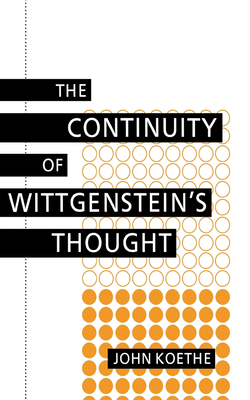
Ludwig Wittgenstein's philosophical work is informed throughout by a particular broad theme: that the semantic and mentalistic attributes of language and human life are shown by verbal and nonverbal conduct, but that they resist incorporation into the domain of the straightforwardly factual. So argues John Koethe, in contrast to the standard view that Wittgenstein's earlier and later philosophical positions are sharply opposed.According to the received view, Wittgenstein's thinking underwent a radical transformation after the Tractatus, leading him to abandon classical realism and to develop an alternative semantics based on the notion of warranted assertability. Koethe maintains that the thesis that semantic claims are not made true by any facts whatsoever, which was a central part of Wittgenstein's early theory of elementary propositions, was one he continued to develop in his later writings, and that it is perfectly compatible with classical realism. In making his case for the essential continuity of Wittgenstein's thought, Koethe ranges over the entire corpus of the philosopher's writing, and concludes by pointing out connections between Wittgenstein's views and those of several contemporary philosophers, including Nagel, Dennett, Davidson, and Dummett.
John Koethe is Professor of Philosophy at the University of Wisconsin, Milwaukee. His award-winning poetry has been widely published.
Contributor(s)
Author
Free shipping on orders over $75. Standard shipping takes 3-7 business days. Returns accepted within 30 days of purchase.