
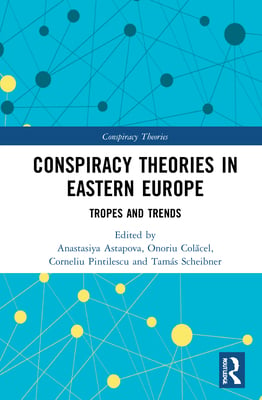
Conspiracy Theories in Eastern Europe: Tropes and Trends - Hardcover
Pay over time for orders over $35.00 with
Offers & Perks
Earn 188 points with this purchase
Added to your rewards balance after checkout.
100 points welcome bonus
Create an account and start with extra points.
This collection of state-of-the-art essays explores conspiracy cultures in post-socialist Eastern Europe, ranging from the nineteenth century to contemporary manifestations.
Conspiracy theories about Freemasons, Communists and Jews, about the Chernobyl disaster, and about George Soros and the globalist elite have been particularly influential in Eastern Europe, but they have also been among the most prominent worldwide. This volume explores such conspiracy theories in the context of local Eastern European histories and discourses. The chapters identify four major factors that have influenced cultures of conspiracy in Eastern Europe: nationalism (including ethnocentrism and antisemitism), the socialist past, the transition period, and globalization. The research focuses on the impact of imperial legacies, nation-building, and the Cold War in the creation of conspiracy theories in Eastern Europe; the effects of the fall of the Iron Curtain and conspiracism in a new democratic setting; and manifestations of viral conspiracy theories in contemporary Eastern Europe and their worldwide circulation with the global rise of populism. Bringing together a diverse landscape of Eastern European conspiracism that is a result of repeated exchange with the "West," the book includes case studies that examine the history, legacy, and impact of conspiracy cultures of Bulgaria, Estonia, Hungary, Moldova, Poland, Romania, Russia, Slovakia, Ukraine, the former Yugoslav countries, and the former Soviet Union.
The book will appeal to scholars and students of conspiracy theories, as well as those in the areas of political science, area studies, media studies, cultural studies, psychology, philosophy, and history, among others. Politicians, educators, and journalists will find this book a useful resource in countering disinformation in and about the region.
Anastasiya Astapova is a research fellow at the Department of Estonian and Comparative Folklore at the University of Tartu, Estonia.
Onoriu Colăcel is senior lecturer in English at Ștefan cel Mare University of Suceava, Romania.
Corneliu Pintilescu is a researcher at the George Baritiu History Institute (in Cluj-Napoca) of the Romanian Academy.
Tamás Scheibner is assistant professor in literary and cultural studies at the University of Budapest (ELTE), Hungary, and senior research fellow in contemporary history at the Research Centre for the Humanities, Hungarian Academy of Sciences Institute of Excellence.
Contributor(s)
Free shipping on orders over $75. Standard shipping takes 3-7 business days. Eligible items may be returned within 30 days of delivery. Conditions apply.