
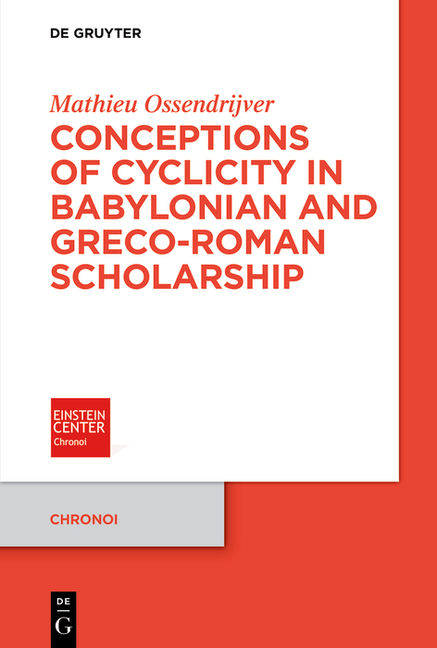
Conceptions of Cyclicity in Babylonian and Greco-Roman Scholarship - Paperback
Pay over time for orders over $35.00 with
Offers & Perks
Earn 25 points with this purchase
Added to your rewards balance after checkout.
100 points welcome bonus
Create an account and start with extra points.
What did ancient Mesopotamian, Greek, and Roman scholars know about the cyclicity of astronomical phenomena, how did they conceptualize cyclicity, and which other phenomena did they consider to be cyclical? This study explores astronomical, astrological, and other scholarly sources, including previously ignored ones, in order to answer these questions. Particular attention is paid to the role of planetary cycles and questions of cross-cultural knowledge transfer. A new account is given of how knowledge of cyclicity, its conceptualization, and its use in predictive practices developed in Babylonia and the Greco-Roman world from the first millennium BCE until Late Antiquity. It is argued that the predictive turn in Babylonian astronomy and astrology led to a new understanding of how astronomical and earthly phenomena are interconnected through time and space. The emergence of horoscopic astrology led to the question of whether human existence is determined by cycles. Even the universe as a whole is governed by cycles according to Plato and later Greco-Roman scholars.
Mathieu A.J.H. Ossendrijver, Freie Universität Berlin, Germany.
Contributor(s)
Author
Free shipping on orders over $75. Standard shipping takes 3-7 business days. Eligible items may be returned within 30 days of delivery. Conditions apply.