
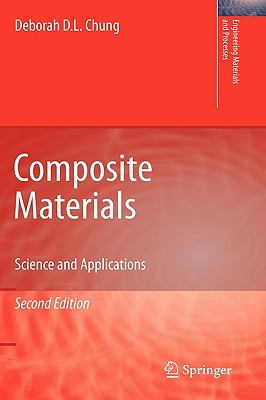
Composite Materials: Science and Applications - Hardcover
$247.99
$249.99
-1%Quantity
01
Pay over time for orders over $35.00 with
Offers & Perks
Earn 247 points with this purchase
Added to your rewards balance after checkout.
100 points welcome bonus
Create an account and start with extra points.
Availability:In StockContributor:Deborah D. L. ChungSeries:Engineering Materials and ProcessesPublish date:3/29/2010Pages:371
Languages:EnglishPublisher:SpringerISBN-13:9781848828308ISBN-10:1848828306UPC:9781848828308Book Category:Technology & Engineering, ScienceBook Subcategory:Materials Science, Textiles & Polymers, PhysicsBook Topic:Ceramics, Condensed MatterSize:9.21 x 6.14 x 0.81 inchesWeight:0.69Product ID:SCY155QNSS
The ?eld of composite materials has progressed greatly over the last few decades, as shown by the widespread use of ?brous composite - terials for airframes, sporting goods and other lightweight structures. Enabling this technological progress is scienti?c understanding of the design and mechanics of composite materials that involve continuous ?bers as the reinforcement. Current challenges in the ?eld of composite materials are associated with the extension of the ?eld of composite materials from structural composites to functional and multifunctional composites, the dev- opment of composite materials for electrical, thermal and other fu- tional applications that are relevant to current technological needs, and the improvement of composite materials through processing. Ex- ples of functions are joining (e. g., brazing), repair, sensing, actuation, deicing (as needed for aircraft and bridges), energy conversion (as needed to generate clean energy), electrochemical electrodes, el- trical connection, thermal contact improvement and heat dissipation (i. e., cooling, as needed for microelectronics and aircraft). Processing includes the use of additives (which may be introduced as liquids or solids), the combined use of ?llers (including discontinuous ones) at the micrometer and nanometer scales, the formation of hybrids (such as organic-inorganic hybrids), the modi?cation of the interfaces in a composite, and control over the microstructure. In other words, the development of composite materials for current technological needs must be application driven and process oriented. This is in contrast to the conventional composites engineering approach, which focuses on mechanics and purely structural applications.
Languages:EnglishPublisher:SpringerISBN-13:9781848828308ISBN-10:1848828306UPC:9781848828308Book Category:Technology & Engineering, ScienceBook Subcategory:Materials Science, Textiles & Polymers, PhysicsBook Topic:Ceramics, Condensed MatterSize:9.21 x 6.14 x 0.81 inchesWeight:0.69Product ID:SCY155QNSS
Deborah D.L. Chung is Professor in the Department of Mechanical and Aerospace Engineering at the University of Buffalo, USA. She has a PhD in Materials Science from the Massachusetts Institute of Technology, USA.
Publisher: Springer
Edition
2nd 2010 Edition
Contributor(s)
Author
Free shipping on orders over $75. Standard shipping takes 3-7 business days. Eligible items may be returned within 30 days of delivery. Conditions apply.