
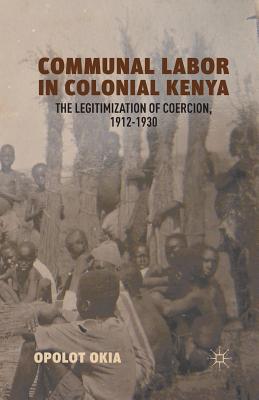
Communal Labor in Colonial Kenya: The Legitimization of Coercion, 1912-1930 - Paperback
by O. Okia
$54.99
Choose Option
Paperback
$54.99

Hardcover
$54.99
Quantity
01
Pay over time for orders over $35.00 with
Offers & Perks
Earn 54 points with this purchase
Added to your rewards balance after checkout.
100 points welcome bonus
Create an account and start with extra points.
Availability:In StockContributor:O. OkiaTheme:Chronological Period/20th Century, Cultural Region/African, Cultural Region/British, Cultural Region/East AfricaPublish date:7/25/2012Pages:186
Languages:EnglishPublisher:Palgrave MacMillanISBN-13:9781349352159ISBN-10:1349352152UPC:9781349352159Book Category:History, Social ScienceBook Subcategory:Africa, Modern, EnslavementBook Topic:East, 20th CenturySize:8.50 x 5.50 x 0.42 inchesWeight:0.232Product ID:SCA474TPK0
This book advances research into the government-forced labor used widely in colonial Kenya from 1930 to 1963 after the passage of the International Labor Organization's Forced Labour Convention. While the 1930 Convention intended to mark the suppression of forced labor practices, various exemptions meant that many coercive labor practices continued in colonial territories. Focusing on East Africa and the Kenya Colony, this book shows how the colonial administration was able to exploit the exemption clause for communal labor, thus ensuring the mobilization of African labor for infrastructure development. As an exemption, communal labor was not defined as forced labor but instead justified as a continuation of traditional African and community labor practices. Despite this ideological justification, the book shows that communal labour was indeed an intensification of coercive labor practices and one that penalized Africans for non-compliance with fines or imprisonment. The use of forcedlabor before and after the passage of the Convention is examined, with a focus on its use during World War II as well as in efforts to combat soil erosion in the rural African reserve areas in Kenya. The exploitation of female labor, the Mau Mau war of the 1950s, civilian protests, and the regeneration of communal labor as harambee after independence are also discussed.
Languages:EnglishPublisher:Palgrave MacMillanISBN-13:9781349352159ISBN-10:1349352152UPC:9781349352159Book Category:History, Social ScienceBook Subcategory:Africa, Modern, EnslavementBook Topic:East, 20th CenturySize:8.50 x 5.50 x 0.42 inchesWeight:0.232Product ID:SCA474TPK0
Opolot Okia is Professor of African History at Wright State University, USA. He is the author of Communal Labor in Colonial Kenya: The Legitimization of Coercion, 1912-1930 (Palgrave Macmillan, 2012) and was previously a Fulbright Scholar at Makerere University in Uganda and Moi University in Kenya.
Publisher: Palgrave MacMillan
Edition
2012 Edition
Free shipping on orders over $75. Standard shipping takes 3-7 business days. Returns accepted within 30 days of purchase.