
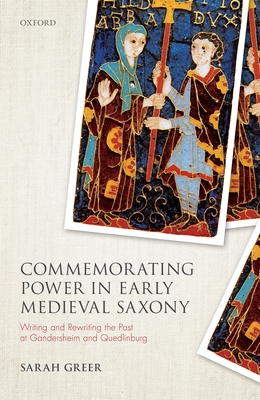
Commemorating Power in Early Medieval Saxony: Writing and Rewriting the Past at Gandersheim and Quedlinburg - Hardcover
by Sarah Greer
$125.99
Quantity
01
Pay over time for orders over $35.00 with
Offers & Perks
Earn 125 points with this purchase
Added to your rewards balance after checkout.
100 points welcome bonus
Create an account and start with extra points.
Availability:In StockContributor:Sarah GreerSeries:Studies in German HistoryTheme:Chronological Period/Medieval (500-1453) Studies, Religious Orientation/ChristianPublish date:1/26/2022Pages:222
In the early medieval world, the way people remembered the past changed how they saw the present. New accounts of former leaders and their deeds could strengthen their successors, establish novel claims to power, or criticize the current ruler. After 888, when the Carolingian Empire fractured into the smaller kingdoms of medieval western Europe, memory became a vital tool for those seeking to claim royal power for themselves. Commemorating Power in Early Medieval Saxony looks at how the past was evoked for political purposes under a new Saxon dynasty, the Ottonians, who came to dominate post-Carolingian Europe as the rulers of a new empire in Germany and Italy. With the accession of the first Ottonian king, Henry I, in 919, sites commemorating the king's family came to the foreground of the medieval German kingdom. The most remarkable of these were two convents of monastic women, Gandersheim and Quedlinburg, whose prominence and prestige in Ottonian politics have been seen as exceptional in the history of early medieval western Europe. In this volume, Sarah Greer offers a fresh interpretation of how these convents became central sites in the new Ottonian empire by revealing how the women in these communities themselves were skilful political actors who were more than capable of manipulating memory for their own benefit. In this first major study in English of how these Saxon convents functioned as memorial centres, Greer presents a new vision of the first German dynasty, one characterized by contingency, versatility, and the power of the past.
Sarah Greer, Leverhulme Early Career Fellow, University of Oxford Sarah Greer is a Leverhulme Early Career Fellow based at the University of Oxford, working on how early medieval dynasties in Western Europe were remembered at their burial sites in the tenth and eleventh centuries.
She completed her undergraduate and Master's degrees at the University of Auckland in New Zealand before moving to the United Kingdom to study for her PhD at the University of St Andrews.
She completed her undergraduate and Master's degrees at the University of Auckland in New Zealand before moving to the United Kingdom to study for her PhD at the University of St Andrews.
Publisher: Oxford University Press
Contributor(s)
Author
Free shipping on orders over $75. Standard shipping takes 3-7 business days. Eligible items may be returned within 30 days of delivery. Conditions apply.