
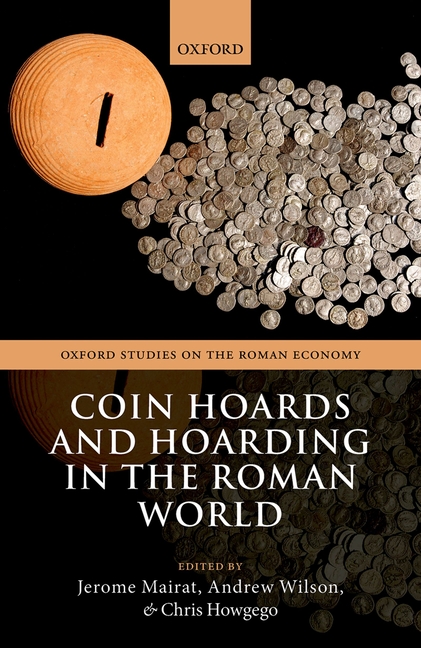
Coin Hoards and Hoarding in the Roman World - Hardcover
$161.99
Quantity
01
Pay over time for orders over $35.00 with
Offers & Perks
Earn 161 points with this purchase
Added to your rewards balance after checkout.
100 points welcome bonus
Create an account and start with extra points.
Availability:In StockContributor:Jerome Mairat, Andrew Wilson, Chris HowgegoSeries:Oxford Studies on the Roman EconomyTheme:Chronological Period/Ancient (To 499 A.D.)Publish date:8/17/2022Pages:370
Languages:EnglishPublisher:Oxford University PressISBN-13:9780198866381ISBN-10:0198866380UPC:9780198866381Book Category:History, Business & EconomicsBook Subcategory:Ancient, Economic HistorySize:9.39 x 6.29 x 1.15 inchesWeight:0.69Product ID:SC8KMG7S39
Coin Hoards and Hoarding in the Roman World presents fourteen chapters from an interdisciplinary group of Roman numismatists, historians, and archaeologists, discussing coin hoarding in the Roman Empire from c. 30 BC to AD 400. The book illustrates the range of research themes being addressed by those connected with the Coin Hoards of the Roman Empire Project, which is creating a database of all known Roman coin hoards from Augustus to AD 400. The volume also reflects the range of the Project's collaborations, with chapters on the use of hoard data to address methodological considerations or monetary history, and coverage of hoards from the west, centre, and east of the Roman Empire, essential to assess methodological issues and interpretations in as broad a context as possible. Chapters on methodology and metrology introduce statistical tools for analysing patterns of hoarding, explore the relationships between monetary reforms and hoarding practices, and address the question of value, emphasizing the need to consider the whole range of precious metal artefacts hoarded. Several chapters present regional studies, from Britain to Egypt, conveying the diversity of hoarding practices across the Empire, the differing methodological challenges they face, and the variety of topics they illuminate. The final group of chapters examines the evidence of hoarding for how long coins stayed in circulation, illustrating the importance of hoard evidence as a control on the interpretation of single coin finds, the continued circulation of Republican coins under the Empire, and the end of the small change economy in Northern Gaul.
Languages:EnglishPublisher:Oxford University PressISBN-13:9780198866381ISBN-10:0198866380UPC:9780198866381Book Category:History, Business & EconomicsBook Subcategory:Ancient, Economic HistorySize:9.39 x 6.29 x 1.15 inchesWeight:0.69Product ID:SC8KMG7S39
Jerome Mairat, Ashmolean Museum, University of Oxford, Andrew Wilson, University of Oxford, Chris Howgego, University of Oxford Jerome Mairat is curator of the Heberden Coin Room in the Ashmolean Museum, Oxford, in charge of the digitization of the collection. His research focuses on the Roman coinage of the third century AD, both imperial and provincial. He is a co-author of Roman Provincial Coinage, volume IX, AD 249-254 (British Museum, 2016), General Editor of Roman Provincial Coinage, and Director of RPC online. Andrew Wilson is Professor of the Archaeology of the Roman Empire at the University of Oxford. His research interests include the economy of the Roman Empire, ancient technology, ancient water supply and usage, Roman North Africa, and archaeological field surveys. He is the co-editor of The Economy of Pompeii (OUP, 2017, with Miko Flohr), Trade, Commerce, and the State in the Roman World (OUP, 2018, with Alan Bowman), and Recycling and Reuse in the Roman Economy (OUP, 2020, with Chloë N. Duckworth) Chris Howgego is Keeper of the Heberden Coin Room, Ashmolean Museum, and Professor of Greek and Roman Numismatics in the University of Oxford. He is the author of Ancient History from Coins (Routledge, 1995), and has written widely on Roman coinage and history. He was the founding Director of Roman Provincial Coinage Online and, with Andrew Wilson, of the Coin Hoards of the Roman Empire project; he continues to co-direct both projects. He is also an editor of the series Roman Imperial Coinage and Roman Provincial Coinage.
Publisher: Oxford University Press
Contributor(s)
Free shipping on orders over $75. Standard shipping takes 3-7 business days. Eligible items may be returned within 30 days of delivery. Conditions apply.