
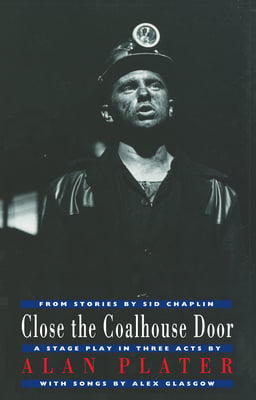
Close the Coalhouse Door: A Stage Play in Three Acts from Stories by Sid Chaplin - Paperback
by Alan Plater
$12.99
$17.95
-28%Quantity
01
Pay over time for orders over $35.00 with
Offers & Perks
Earn 12 points with this purchase
Added to your rewards balance after checkout.
100 points welcome bonus
Create an account and start with extra points.
Availability:In StockContributor:Alan Plater, Sid Chaplin, Alex GlasgowSeries:DramaPublish date:6/27/2000Pages:110
Close the Coalhouse Door is a living pageant of the North-East's mining communities, and also a key work in the development of British political drama. Triumphantly revived by Live Theatre, this gritty musical is regularly staged by all kinds of theatre companies, from professional to school and amateur. The original version was published by Samuel French. This new edition, using the updated script, was published in response to demand from the numerous theatre groups which want to perform it. Alan Plater wrote: 'Some plays refuse to lie down. Others surrender on the first night and disappear into a mysterious other country - the land of lost plays. Nobody can explain this phenomenon. Shakespeare himself had no idea how many people would turn up on the night. Close the Coalhouse Door was written, with the wise and loving inspiration of Sid Chaplin and adorned by the songs of Alex Glasgow, in 1968. It has been revived at regular intervals ever since. Initially we updated it, to accommodate Edward Heath and the miners' strikes; but eventually time took its revenges. In 1968 we had a cast of ten plus walk-ons, five musicians and a full brass band on special occasions. The new version is written for a cast of eight, who made their own music, again with a brass band on special occasions. Theatrical resources have shrunk, though not as drastically as the coal industry. The soul of the piece is unchanging. We originally described it as "a hymn of unqualified praise to the miners - who created a revolutionary weapon without having a revolutionary intent". If, today, the hymn is more in the nature of an elegy, it is a strain that haunts the dreams of everyone with roots in the North-East.'
Alan Plater (1935-2010) was born in Jarrow, brought up in Hull, and became a full-time writer in 1961, with over 200 assorted credits in radio, television, theatre and film. His plays have been performed at many British theatres, including Hull Truck, London's Bush Theatre and the Theatre Royal, Stratford East, and Newcastle's Live Theatre, Theatre Royal and Newcastle Playhouse. His TV work included Z Cars, The Barchester Chronicles, The Beiderbecke Trilogy, Fortunes of War and A Very British Coup. His most recent work included a memoir, Doggin' Around, the stage plays, Shooting the Legend and Peggy for You, the novel Oliver's Travels, seen on TV in a controversial dramatisation, as well as contributions to the BBC series Dalziel and Pascoe. He was President of the Writers' Guild of Great Britain from 1991 to 1995, and was given a CBE for services to drama in 2004.
Publisher: Bloodaxe Books
Edition
Revised Edition
Contributor(s)
Author
Free shipping on orders over $75. Standard shipping takes 3-7 business days. Eligible items may be returned within 30 days of delivery. Conditions apply.