
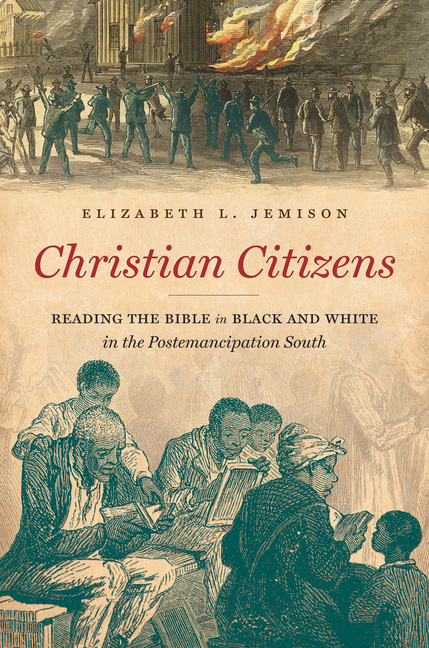
Christian Citizens: Reading the Bible in Black and White in the Postemancipation South - Hardcover
$115.99
Choose Option
Hardcover
$115.99
$105.00

Christian Citizens: Reading the Bible in Black and White in the Postemancipation South
$34.99
Quantity
01
Pay over time for orders over $35.00 with
Offers & Perks
Earn 115 points with this purchase
Added to your rewards balance after checkout.
100 points welcome bonus
Create an account and start with extra points.
Availability:In StockContributor:Elizabeth L. JemisonTheme:Cultural Region/South, Ethnic Orientation/African American, Religious Orientation/ChristianPublish date:11/23/2020Pages:242
Languages:EnglishPublisher:University of North Carolina PressISBN-13:9781469659688ISBN-10:1469659689UPC:9781469659688Book Category:Religion, Social Science, HistoryBook Subcategory:Christianity, Cultural & Ethnic Studies, United StatesBook Topic:History, African American & Black Studies, State & LocalSize:9.21 x 6.14 x 0.69 inchesWeight:0.549Product ID:SCAXZQY14B
With emancipation, a long battle for equal citizenship began. Bringing together the histories of religion, race, and the South, Elizabeth L. Jemison shows how southerners, black and white, drew on biblical narratives as the basis for very different political imaginaries during and after Reconstruction. Focusing on everyday Protestants in the Mississippi River Valley, Jemison scours their biblical thinking and religious attitudes toward race. She argues that the evangelical groups that dominated this portion of the South shaped contesting visions of black and white rights.
Black evangelicals saw the argument for their identities as Christians and as fully endowed citizens supported by their readings of both the Bible and U.S. law. The Bible, as they saw it, prohibited racial hierarchy, and Amendments 13, 14, and 15 advanced equal rights. Countering this, white evangelicals continued to emphasize a hierarchical paternalistic order that, shorn of earlier justifications for placing whites in charge of blacks, now fell into the defense of an increasingly violent white supremacist social order. They defined aspects of Christian identity so as to suppress black equality--even praying, as Jemison documents, for wisdom in how to deny voting rights to blacks. This religious culture has played into remarkably long-lasting patterns of inequality and segregation.
Black evangelicals saw the argument for their identities as Christians and as fully endowed citizens supported by their readings of both the Bible and U.S. law. The Bible, as they saw it, prohibited racial hierarchy, and Amendments 13, 14, and 15 advanced equal rights. Countering this, white evangelicals continued to emphasize a hierarchical paternalistic order that, shorn of earlier justifications for placing whites in charge of blacks, now fell into the defense of an increasingly violent white supremacist social order. They defined aspects of Christian identity so as to suppress black equality--even praying, as Jemison documents, for wisdom in how to deny voting rights to blacks. This religious culture has played into remarkably long-lasting patterns of inequality and segregation.
Languages:EnglishPublisher:University of North Carolina PressISBN-13:9781469659688ISBN-10:1469659689UPC:9781469659688Book Category:Religion, Social Science, HistoryBook Subcategory:Christianity, Cultural & Ethnic Studies, United StatesBook Topic:History, African American & Black Studies, State & LocalSize:9.21 x 6.14 x 0.69 inchesWeight:0.549Product ID:SCAXZQY14B
Jemison, Elizabeth L.: - Elizabeth L. Jemison is assistant professor of religion at Clemson University.
Publisher: University of North Carolina Press
Contributor(s)
Author
Free shipping on orders over $75. Standard shipping takes 3-7 business days. Eligible items may be returned within 30 days of delivery. Conditions apply.