
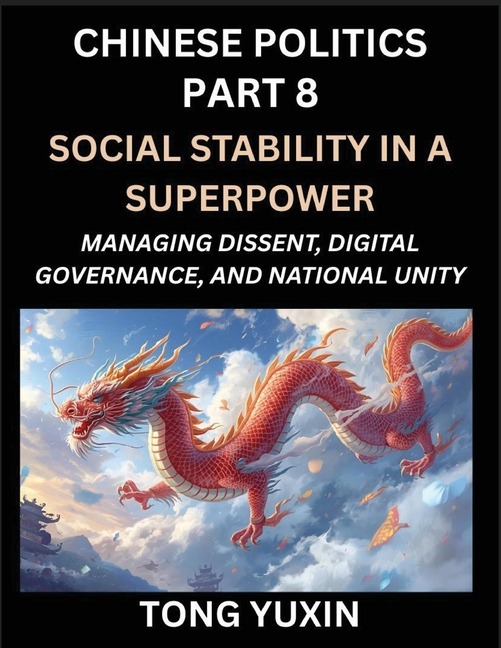
Chinese Politics (Part 8)- Social Stability in a Superpower, Managing Dissent, Digital Governance, and National Unity, China's Quest for Managing Urba - Paperback
by Yuxin Tong
$45.99
$49.99
-8%Quantity
01
Pay over time for orders over $35.00 with
Offers & Perks
Earn 45 points with this purchase
Added to your rewards balance after checkout.
100 points welcome bonus
Create an account and start with extra points.
Availability:In StockContributor:Yuxin TongTheme:Cultural Region/ChinesePublish date:10/28/2025Pages:104
Languages:EnglishPublisher:Chinese PoliticsISBN-13:9798895843291UPC:9798895843291Book Category:Literary Collections, History, Political ScienceBook Subcategory:Asian, Asia, Comparative PoliticsBook Topic:Chinese, ChinaSize:11.00 x 8.50 x 0.22 inchesWeight:0.263Product ID:SC8ZDQ5F8E
Over the past forty years, China's story has been nothing short of extraordinary. Once a nation struggling with widespread poverty and economic stagnation, it has risen to become the world's second-largest economy-a transformation many deemed impossible. But this economic revolution was no accident. It was the result of deliberate, far-sighted political decisions that reshaped not just markets, but the very fabric of Chinese society.At the core of this metamorphosis was political will-a steadfast commitment from China's leaders to pursue reform even when risks loomed large. Unlike Western economies, which often rely on incremental adjustments, China's approach combined centralized vision with localized innovation. Policies like "reform and opening-up" (改革开放 gǎigé kāifàng) created space for experimentation, allowing provinces and cities to adapt national strategies to their unique circumstances.Take, for example, the dismantling of agricultural collectivization (人民公社 rénmín gōngshè) in the late 1970s. By breaking up inefficient communes and allowing farmers to keep surplus crops, productivity soared. Rural incomes doubled within a decade, laying the foundation for a consumer-driven economy. Similarly, the gradual opening of sectors to foreign investment (外资 wàizī) transformed coastal cities into manufacturing hubs, while SOE reforms turned sluggish state-owned enterprises into agile competitors.But growth was never uniform. Rural revitalization (乡村振兴 xiāngcūn zhènxīng) programs became essential to bridge the widening urban-rural divide (城乡差距 chéngxiāng chājù), ensuring that prosperity reached inland provinces. Meanwhile, China's leaders navigated global crises-from the 1997 Asian Financial Crisis to the 2008 Global Recession-by turning challenges into opportunities for reform.What emerges is a portrait of institutional flexibility: a government willing to pivot when necessary, yet unwavering in its long-term goals. This book delves into the policy choices, debates, and compromises that defined China's rise. It asks not just how China grew, but why its leaders made the decisions they did-and what those choices reveal about the nature of governance in a rapidly changing world.As China faces new uncertainties-from demographic shifts to technological disruption-its past offers critical lessons. This is more than an economic success story; it is a testament to how visionary governance can transform a nation. By examining the interplay of politics and economics, we uncover the secrets behind China's ascent-and the challenges that lie ahead.
Languages:EnglishPublisher:Chinese PoliticsISBN-13:9798895843291UPC:9798895843291Book Category:Literary Collections, History, Political ScienceBook Subcategory:Asian, Asia, Comparative PoliticsBook Topic:Chinese, ChinaSize:11.00 x 8.50 x 0.22 inchesWeight:0.263Product ID:SC8ZDQ5F8E
Free shipping on orders over $75. Standard shipping takes 3-7 business days. Eligible items may be returned within 30 days of delivery. Conditions apply.