
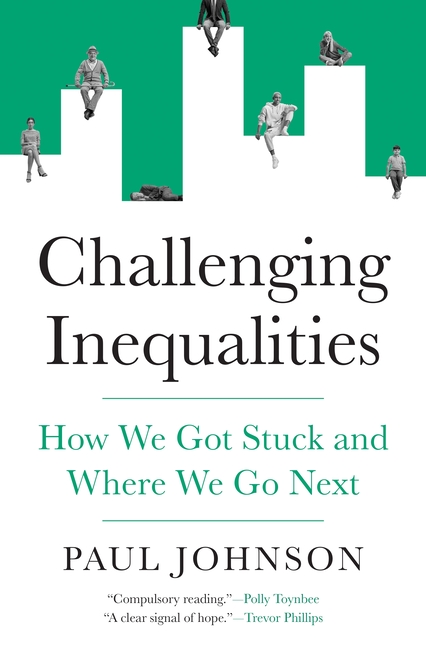
Challenging Inequalities: How We Got Stuck and Where We Go Next - Hardcover
by Paul Johnson
$32.99
Quantity
01
Pay over time for orders over $35.00 with
Offers & Perks
Earn 32 points with this purchase
Added to your rewards balance after checkout.
100 points welcome bonus
Create an account and start with extra points.
Languages:EnglishPublisher:Princeton University PressISBN-13:9780691283555ISBN-10:0691283559UPC:9780691283555Book Category:Social Science, Business & EconomicsBook Subcategory:Social Classes & Economic Disparity, Economic History, Public FinanceSize:9.30 x 6.10 x 1.10 inchesWeight:0.59Product ID:SCGBZ78P07
A comprehensive look at inequalities and why they matter
There is a widespread sense throughout the developed world that progress towards a better society has stalled. Many countries, including the UK, have experienced persistent economic stagnation accompanied by declining trust in institutions. Governments are struggling to respond not only to traditional economic problems but also to newer challenges posed by climate change, migration and technological change. Challenging Inequalities, written by Paul Johnson and coauthors, drawing on the findings of the six-year IFS Deaton Review, connects these conditions to inequality--inequality not just of income and wealth but of health, political participation and opportunity. It not only offers a detailed analysis of the different forms of inequalities but also an in-depth consideration of why inequalities matter, how they have changed and what can, or should, be done about them. The book explains the enduring effects of early life experiences and education and examines the trends in employment and earnings over recent decades. It argues that economic stagnation since the financial crises of 2008-2009 has exposed inequalities originating in the 1980s. Not only have incomes stagnated, but so has progress towards reducing health inequalities and dealing with inequalities across gender, ethnicity, geography, age and educational level. The combination of earnings inequality and economic stagnation has led to the growing importance of wealth, the increasing concentration of economic power in an older generation and a decline in social mobility. Economic inequalities have also resulted directly in dangerous differences between regions and in political power across groups. The need to address inequality has never been more urgent. Challenging Inequalities offers a road map for how we have arrived at such a perilous spot--and how we can change course to achieve better outcomes for all.Languages:EnglishPublisher:Princeton University PressISBN-13:9780691283555ISBN-10:0691283559UPC:9780691283555Book Category:Social Science, Business & EconomicsBook Subcategory:Social Classes & Economic Disparity, Economic History, Public FinanceSize:9.30 x 6.10 x 1.10 inchesWeight:0.59Product ID:SCGBZ78P07
Paul Johnson is provost of the Queen's College, University of Oxford, and former director of the Institute for Fiscal Studies (IFS). He is the author of the Sunday Times bestseller Follow the Money.
Co-authored with: James Banks is professor of economics at the University of Manchester and senior research fellow at the IFS, where he is co-director of the Centre for the Microeconomic Analysis of Public Policy (CPP). Tim Besley is school professor of economics and political science and the W. Arthur Lewis Professor of Development Economics at the London School of Economics and Political Science. Richard Blundell is codirector of the CPP and former research director at IFS. He holds the David Ricardo Chair of Political Economy at University College London. Angus Deaton is the Dwight D. Eisenhower Professor of International Aff airs, Emeritus, Professor of Economics and International Affairs, Emeritus, and Senior Scholar at Princeton University. He was awarded the Nobel Prize in Economic Sciences in 2015 for his analysis of consumption, poverty and welfare. Robert Joyce is director at Alma Economics. Previously, he was deputy director at the IFS, where he led the Income, Work and Welfare sector. Debra Satz is the Vernon R. and Lysbeth Warren Anderson Dean of the School of Humanities and Sciences at Stanford University, where she is also the Marta Sutton Weeks Professor of Ethics in Society and professor of philosophy.Publisher: Princeton University Press
Contributor(s)
Author
Free shipping on orders over $75. Standard shipping takes 3-7 business days. Eligible items may be returned within 30 days of delivery. Conditions apply.