
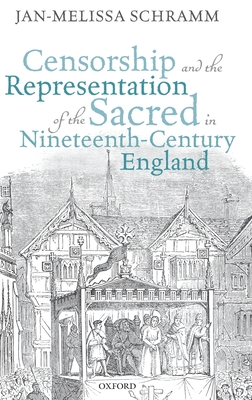
Censorship and the Representation of the Sacred in Nineteenth-Century England - Hardcover
$125.99
Quantity
01
Pay over time for orders over $35.00 with
Offers & Perks
Earn 125 points with this purchase
Added to your rewards balance after checkout.
100 points welcome bonus
Create an account and start with extra points.
Availability:In StockContributor:Jan-Melissa SchrammTheme:Chronological Period/19th CenturyPublish date:7/23/2019Pages:288
Languages:EnglishPublisher:Oxford University PressISBN-13:9780198826064ISBN-10:0198826060UPC:9780198826064Book Category:Literary Criticism, Political ScienceBook Subcategory:Modern, CensorshipBook Topic:19th CenturySize:9.30 x 6.20 x 1.10 inchesWeight:0.613Product ID:SC9ERQTXJE
Throughout the nineteenth century, the performance of sacred drama on the English public stage was prohibited by law and custom left over from the Reformation: successive Examiners of Plays, under the control of the Lord Chamberlain's Office, censored and suppressed both devotional and blasphemous plays alike. Whilst the Biblical sublime found expression in the visual arts, the epic, and the oratorio, nineteenth-century spoken drama remained secular by force of precedent and law. The maintenance of this ban was underpinned by Protestant anxieties about bodily performance, impersonation, and the power of the image that persisted long after the Reformation, and that were in fact bolstered by the return of Catholicism to public prominence after the passage of the Catholic Relief Act in 1829 and the restoration of the Catholic Archbishoprics in 1850. But even as anti-Catholic prejudice at mid-century reached new heights, the turn towards medievalism in the visual arts, antiquarianism in literary history, and the 'popular' in constitutional reform placed England's pre- Reformation past at the centre of debates about the uses of the public stage and the functions of a truly national drama. This book explores the recovery of the texts of the extant mystery-play cycles undertaken by antiquarians in the early nineteenth century and the eventual return of sacred drama to English public theatres at the start of the twentieth century. Consequently, law, literature, politics, and theatre history are brought into conversation with one another in order to illuminate the history of sacred drama and Protestant ant-theatricalism in England in the long nineteenth-century.
Languages:EnglishPublisher:Oxford University PressISBN-13:9780198826064ISBN-10:0198826060UPC:9780198826064Book Category:Literary Criticism, Political ScienceBook Subcategory:Modern, CensorshipBook Topic:19th CenturySize:9.30 x 6.20 x 1.10 inchesWeight:0.613Product ID:SC9ERQTXJE
Jan-Melissa Schramm, Lecturer in Nineteenth-Century Literature, University of Cambridge, and Fellow in English, Trinity Hall, Cambridge Jan-Melissa Schramm worked as a lawyer in private practice before undertaking a PhD in English Literature. She is a University Lecturer in Nineteenth-Century Literature at the University of Cambridge, a Fellow in English at Trinity Hall, Cambridge, and Deputy Director of the Cambridge Centre for Research in the Arts, Social Sciences, and Humanities (CRASSH). She is the author of two monographs to date, Testimony and Advocacy in Victorian Law, Literature, and Theology (Cambridge University Press, 2000) and Atonement and Self-Sacrifice in Nineteenth-Century Narrative (Cambridge University Press, 2012), and she is co-editor of two volumes of essays, Fictions of Knowledge: Fact, Evidence, Doubt (Macmillan, 2011) and Sacrifice and Modern War Literature (Oxford University Press, 2018).
Publisher: Oxford University Press
Contributor(s)
Author
Free shipping on orders over $75. Standard shipping takes 3-7 business days. Eligible items may be returned within 30 days of delivery. Conditions apply.