
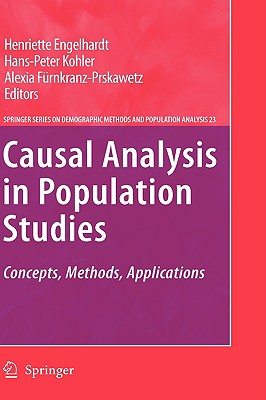
Causal Analysis in Population Studies: Concepts, Methods, Applications - Hardcover
Pay over time for orders over $35.00 with
Offers & Perks
Earn 108 points with this purchase
Added to your rewards balance after checkout.
100 points welcome bonus
Create an account and start with extra points.
The central aim of many studies in population research and demography is to explain cause-effect relationships among variables or events. For decades, population scientists have concentrated their efforts on estimating the 'causes of effects' by applying standard cross-sectional and dynamic regression techniques, with regression coefficients routinely being understood as estimates of causal effects. The standard approach to infer the 'effects of causes' in natural sciences and in psychology is to conduct randomized experiments. In population studies, experimental designs are generally infeasible.
In population studies, most research is based on non-experimental designs (observational or survey designs) and rarely on quasi experiments or natural experiments. Using non-experimental designs to infer causal relationships--i.e. relationships that can ultimately inform policies or interventions--is a complex undertaking. Specifically, treatment effects can be inferred from non-experimental data with a counterfactual approach. In this counterfactual perspective, causal effects are defined as the difference between the potential outcome irrespective of whether or not an individual had received a certain treatment (or experienced a certain cause). The counterfactual approach to estimate effects of causes from quasi-experimental data or from observational studies was first proposed by Rubin in 1974 and further developed by James Heckman and others.
This book presents both theoretical contributions and empirical applications of the counterfactual approach to causal inference.
Edition
2009 Edition
Contributor(s)
Free shipping on orders over $75. Standard shipping takes 3-7 business days. Eligible items may be returned within 30 days of delivery. Conditions apply.