
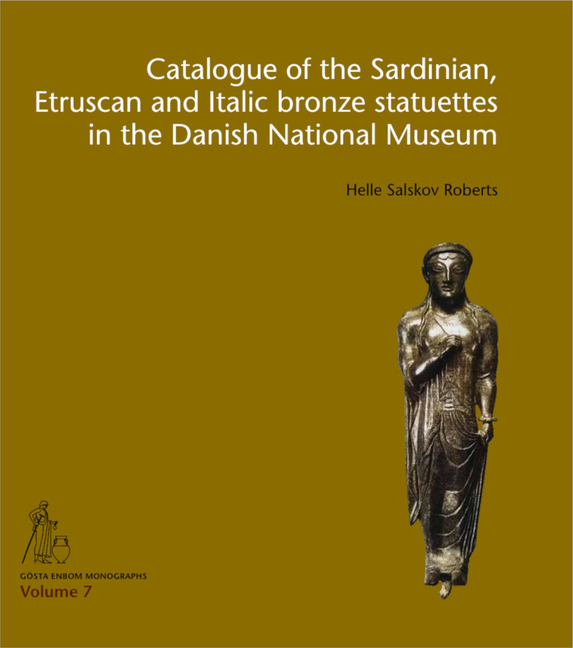
Catalogue of the Sardinian, Etruscan and Italic Bronze Statuettes in the Danish National Museum - Hardcover
$34.99
Quantity
01
Pay over time for orders over $35.00 with
Offers & Perks
Earn 34 points with this purchase
Added to your rewards balance after checkout.
100 points welcome bonus
Create an account and start with extra points.
Availability:In StockContributor:Helle Salskov RobertsSeries:G?sta Enbom MonographsTheme:Chronological Period/Ancient (To 499 A.D.), Cultural Region/ItalyPublish date:9/24/2021Pages:164
Languages:EnglishPublisher:Aarhus University PressISBN-13:9788772194547ISBN-10:8772194545UPC:9788772194547Book Category:History, Social ScienceBook Subcategory:Ancient, ArchaeologyBook Topic:RomeSize:9.40 x 8.90 x 0.70 inchesWeight:0.84Product ID:SC802RRMDA
In the First Millennium BC present-day Italy was inhabited by many different ethnic groups, most of which spoke a language affiliated with Latin. Sardinia, a large island to the West of the Italian mainland, had a culture characterized by nuraghs, a kind of massive stone tower, presumably for defense purposes. Many finds of bronze statuettes of warriors show the concern of the population to protect themselves from aggressors, also with divine support secured by impressive priestesses. However, Rome's closest neighbours to the North were the Etruscans, who spoke a language quite different from any other people in Italy. For a long period Etruscan kings ruled the Romans who, however, liberated themselves from the foreigners and, in reverse, started to conquer their territory. Gradually, from about the Sixth Century BC to about 100 BC, the Romans came to dominate the Etruscans as well as the ethnic groups we call the Italics. But, apart from the military conflict, from which the Romans emerged victorious they were in many ways influenced by the Etruscans, whose prevalence in the field of religion and art they admired. Actually, they welcomed cultural exchange. A striking example is that the Romans invited a famous Etruscan artist to decorate their most important temple, dedicated to Jupiter, on the Capitol Hill. The Etruscan excellence in bronze casting has left a rich heritage of bronze sculpture. Statues and statuettes were used as gifts for the gods in sanctuaries both in Etruria and Rome, as well as in many other parts of Italy.
Languages:EnglishPublisher:Aarhus University PressISBN-13:9788772194547ISBN-10:8772194545UPC:9788772194547Book Category:History, Social ScienceBook Subcategory:Ancient, ArchaeologyBook Topic:RomeSize:9.40 x 8.90 x 0.70 inchesWeight:0.84Product ID:SC802RRMDA
Free shipping on orders over $75. Standard shipping takes 3-7 business days. Eligible items may be returned within 30 days of delivery. Conditions apply.