
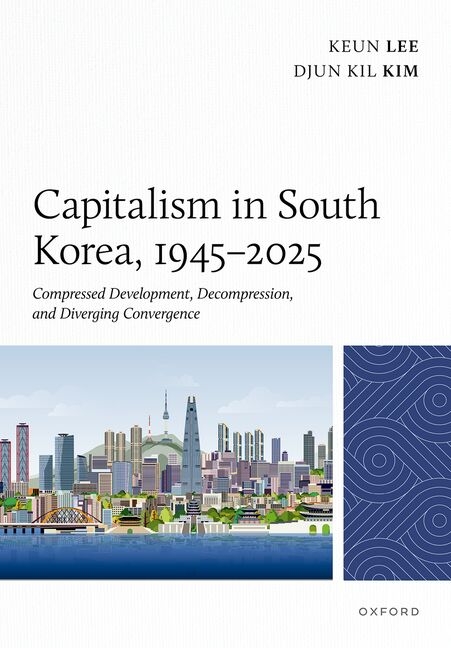
Capitalism in South Korea, 1945-2025: Compressed Development, Decompression, and Diverging Convergence - Hardcover
by Keun Lee, Djun Kil Kim
$109.99
Quantity
01
Pay over time for orders over $35.00 with
Offers & Perks
Earn 109 points with this purchase
Added to your rewards balance after checkout.
100 points welcome bonus
Create an account and start with extra points.
Availability:In StockContributor:Keun Lee, Djun Kil KimTheme:Cultural Region/AsianPublish date:9/1/2026Pages:216
Languages:EnglishPublisher:Oxford University PressISBN-13:9780197852989ISBN-10:019785298XUPC:9780197852989Book Category:Business & Economics, Political Science, Social ScienceBook Subcategory:World, SociologyBook Topic:Asian, Social TheorySize:9.32 x 6.48 x 0.75 inchesWeight:0.481Product ID:SCHZHQZ9R5
Capitalism in South Korea, 1945-2025 provides an interdisciplinary and analytical account of the evolution of South Korea since 1945. This book employs a framework of "compressed development, decompression, and convergence" to better understand Korea's turbulent journey, which has been marked by economic miracles, crises, and, more recently, a slowdown in growth and rising inequality. The book begins by defining "decompression" as political democratization and economic liberalization while demonstrating that economic achievements under the regime of compressed growth enabled the emergence of a Korean middle class that demanded political freedom, facilitating a peaceful transition to democracy in the late 1980s. Capitalism in South Korea, 1945-2025 then goes on to show how the post-crisis reforms imposed by the IMF set Korea on a trajectory of convergence with Anglo-American capitalism and brought an end to the so-called "East Asian miracle". This book highlights the unexpected co-existence of two different paths of convergence displayed by Korea. The first path involves convergence with Anglo-American capitalism, which is characterized by slow growth, worsening inequality, and "free but not-so-clean" democracy. The second path is convergence with the "safe capitalism" of several continental European countries, which is typified by low birth rates, low divorce and crime rates, and long-life expectancy, as well as the pursuit of active labor market policies emulating Northern Europe. Capitalism in South Korea, 1945-2025 concludes that contemporary Korea is undergoing a period of "diverging convergence". That is, Korea shows some signs of converging with certain advanced capitalist nations while also remaining distinct according to various indicators.
Languages:EnglishPublisher:Oxford University PressISBN-13:9780197852989ISBN-10:019785298XUPC:9780197852989Book Category:Business & Economics, Political Science, Social ScienceBook Subcategory:World, SociologyBook Topic:Asian, Social TheorySize:9.32 x 6.48 x 0.75 inchesWeight:0.481Product ID:SCHZHQZ9R5
Keun Lee is a Distinguished Professor of economics at Chung-Ang University and Seoul National University (emeritus). He is the winner of the Schumpeter Prize in 2024 and founding director of the Center for Economic Catch-Up. In 2021 he served as vice-chairman of the National Economic Advisory Council for the chair and the President of Korea. He is a regular writer for Project Syndicate and an editor for Research Policy. His recent books include China's Technological Leapfrogging and Economic Catch-up (2022) which he authored and The Challenges of Technology and Economic Catch-up in Emerging Economies (2021) which he co-edited.
Djun Kil Kim is a fellow of the Center for Economic Catch-up and was a visiting research fellow at the Institute of Economic Research, Seoul National University from 2017 to 2025. He is the author of the 2005 book The History of Korea. In October 2011 he was awarded the "Global Korea Award" by the Council on Korean Studies at Michigan State University. He has taught and conducted research on Korean studies at Yonsei University, Sejong Institute, Chongju University, and Myongji University in Korea, as well as at Brigham Young University in the United States, Stockholm University in Sweden, and the University of Asia and the Pacific in the Philippines. Kim also served in several key government positions in South Korea and prior to this had an extensive Seoul-based journalistic career.
Djun Kil Kim is a fellow of the Center for Economic Catch-up and was a visiting research fellow at the Institute of Economic Research, Seoul National University from 2017 to 2025. He is the author of the 2005 book The History of Korea. In October 2011 he was awarded the "Global Korea Award" by the Council on Korean Studies at Michigan State University. He has taught and conducted research on Korean studies at Yonsei University, Sejong Institute, Chongju University, and Myongji University in Korea, as well as at Brigham Young University in the United States, Stockholm University in Sweden, and the University of Asia and the Pacific in the Philippines. Kim also served in several key government positions in South Korea and prior to this had an extensive Seoul-based journalistic career.
Publisher: Oxford University Press
Contributor(s)
Authors
Free shipping on orders over $75. Standard shipping takes 3-7 business days. Eligible items may be returned within 30 days of delivery. Conditions apply.