
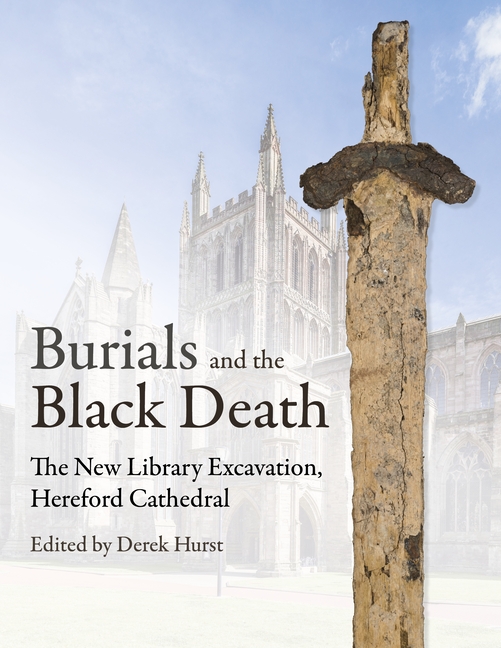
Burials and the Black Death: The New Library Excavation, Hereford Cathedral - Hardcover
$51.99
$59.99
-13%Quantity
01
Pay over time for orders over $35.00 with
Offers & Perks
Earn 51 points with this purchase
Added to your rewards balance after checkout.
100 points welcome bonus
Create an account and start with extra points.
Availability:In StockContributor:Derek HurstTheme:Chronological Period/Medieval (500-1453) Studies, Cultural Region/BritishPublish date:5/31/2026Pages:416
Languages:EnglishPublisher:Oxbow Books LimitedISBN-13:9781789258684ISBN-10:1789258685UPC:9781789258684Book Category:Social Science, HistoryBook Subcategory:Archaeology, EuropeBook Topic:Great BritainSize:12.02 x 8.57 x 1.19 inchesWeight:1.762Product ID:SC47GZ9NKS
Presents new structural evidence for Saxon Hereford, a possible nunnery and bishop's residence, and its ransacking in 1055 by the Welsh.
Excavation at Hereford Cathedral in 1993, prior to the construction of the Mappa Mundi Museum and a new archive library, revealed extensive archaeological remains, commencing with 8th/9th-century buildings and a Saxon cemetery. In the 10th century a well-metalled road surface was constructed. Alongside this, a very substantial building arose, partially built in stone, and with a cellar. Its scale and design indicated this to be the bishop's residence. It was, however, remarkably short-lived. Its cellar became a cesspit, a pattern-welded sword lay on its floor, and overlying fills included an ornate inkwell, and a collection of animal carcasses. Radiocarbon dating suggests the Welsh ransacking of Hereford in 1055 as the context, recorded in historical evidence as disastrous for the cathedral.
The site of the cellared building was later quarried for aggregate, which accords well with major building works during the Norman period, most notably the Losinga Chapel and the new cathedral. A vast amount of mostly Saxon charnel was incorporated into backfilling the quarry, its final deposition being accompanied by inhumation burials, some being irregular. The latter may be linked to the violent hostilities in Hereford (c 1140) during the Anarchy.
From the mid-12th century the site wholly became a cemetery area, and the excavation of about 1000 burials has provided a full cross-section of the medieval population, with their analysis covering aspects such as health, stature and even origins. In the 14th century, three mass burial pits occurred, with dating consistent with the first outbreak of plague, the 'Black Death', in 1349. Associated analysis has contributed to an international study, successfully using ancient DNA analysis to identify the presence of Yersinia pestis, the plague microbe.
This report includes detailed reporting on the finds, particularly the human remains, with the interpretation of the entire stratigraphic sequence underpinned throughout by extensive radiocarbon dating and chronological modelling.
Excavation at Hereford Cathedral in 1993, prior to the construction of the Mappa Mundi Museum and a new archive library, revealed extensive archaeological remains, commencing with 8th/9th-century buildings and a Saxon cemetery. In the 10th century a well-metalled road surface was constructed. Alongside this, a very substantial building arose, partially built in stone, and with a cellar. Its scale and design indicated this to be the bishop's residence. It was, however, remarkably short-lived. Its cellar became a cesspit, a pattern-welded sword lay on its floor, and overlying fills included an ornate inkwell, and a collection of animal carcasses. Radiocarbon dating suggests the Welsh ransacking of Hereford in 1055 as the context, recorded in historical evidence as disastrous for the cathedral.
The site of the cellared building was later quarried for aggregate, which accords well with major building works during the Norman period, most notably the Losinga Chapel and the new cathedral. A vast amount of mostly Saxon charnel was incorporated into backfilling the quarry, its final deposition being accompanied by inhumation burials, some being irregular. The latter may be linked to the violent hostilities in Hereford (c 1140) during the Anarchy.
From the mid-12th century the site wholly became a cemetery area, and the excavation of about 1000 burials has provided a full cross-section of the medieval population, with their analysis covering aspects such as health, stature and even origins. In the 14th century, three mass burial pits occurred, with dating consistent with the first outbreak of plague, the 'Black Death', in 1349. Associated analysis has contributed to an international study, successfully using ancient DNA analysis to identify the presence of Yersinia pestis, the plague microbe.
This report includes detailed reporting on the finds, particularly the human remains, with the interpretation of the entire stratigraphic sequence underpinned throughout by extensive radiocarbon dating and chronological modelling.
Languages:EnglishPublisher:Oxbow Books LimitedISBN-13:9781789258684ISBN-10:1789258685UPC:9781789258684Book Category:Social Science, HistoryBook Subcategory:Archaeology, EuropeBook Topic:Great BritainSize:12.02 x 8.57 x 1.19 inchesWeight:1.762Product ID:SC47GZ9NKS
Hurst, Derek: - Derek Hurst is a senior project manager with Worcestershire Archaeology and heads their post-excavation. With an extensive background in ceramic studies, his principal research interest is in the central role of finds data for the interpretation of sites.
Publisher: Oxbow Books Limited
Contributor(s)
Free shipping on orders over $75. Standard shipping takes 3-7 business days. Eligible items may be returned within 30 days of delivery. Conditions apply.