

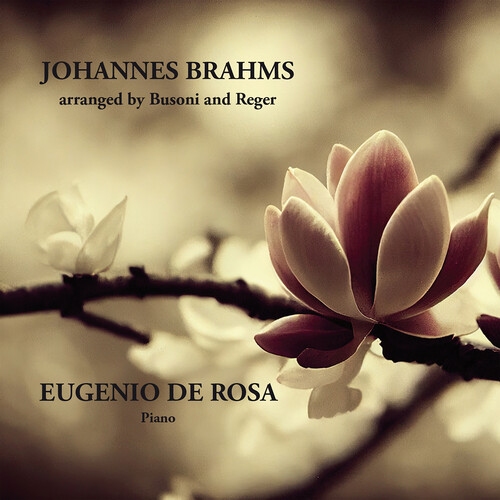
Brahms: Arranged by Busoni & Reger - CD
by Brahms, De Rosa, Johannes Brahms
$13.99
$16.99
-18%Quantity
01
Pay over time for orders over $35.00 with
Offers & Perks
Earn 13 points with this purchase
Added to your rewards balance after checkout.
100 points welcome bonus
Create an account and start with extra points.
Availability:In StockArtists:Brahms, De Rosa, Johannes BrahmsGenre:Classical ArtistsRelease date:2/28/2025Original year:2025
Publisher:MusicaphonLabel:MusicaphonUPC:4012476590141Weight:0.17Discs:1Product ID:SCW2GZWDGX
The "Eleven Choral Preludes for Organ" op. 122 were completed by Johannes Brahms between May and June 1896. It was not until later, in 1902, that op. 122 was published posthumously. At the same time, Brahms' op. 122 did not escape the attention of the Italian composer and pianist Ferruccio Busoni, who decided to transcribe six of the eleven choral preludes for piano. Over the course of his life, he transcribed numerous works by various composers for piano, including those by Bach that were intended for organ, harpsichord or violin.It is little known that Max Reger, in addition to his importance as a composer, was also one of the most important arrangers of the works of great colleagues. He arranged works by almost all the great masters, from Mozart to Richard Strauss. Reger always admired the compact form and the almost ascetic compositional discipline of Johannes Brahms. His admiration for the great North German is confirmed by the elaborate transcriptions of the "Five Slow Movements" from his four symphonies.Reger does not write them in a typically pianistic style, but rather he summarizes the entire melodic and harmonic richness in a kind of symphonic script. These transcriptions are the work of a brilliant musical mind who was able to grasp the music as a whole and, based on a complete understanding of the compositions, to present them in a new guise.The arrangements are extremely demanding for the pianist. It is not only a matter of master-ing the sometimes considerable and often far-reaching mass of notes, but also of allowing the themes woven into them to emerge, as is the case in the orchestra through the characteristics of the individual instruments. Brahms' well-known preference for the so-called "conflict rhythms" makes the task even more difficult.The rarities, so rich and demanding in sound and structure, are appearing on recording for the first time and should inspire many friends of the works of these two composers to take a closer look at them.
Publisher:MusicaphonLabel:MusicaphonUPC:4012476590141Weight:0.17Discs:1Product ID:SCW2GZWDGX
Publisher: Musicaphon
Label: Musicaphon
Artist(s)
Free shipping on orders over $75. Standard shipping takes 3-7 business days. Eligible items may be returned within 30 days of delivery. Conditions apply.