
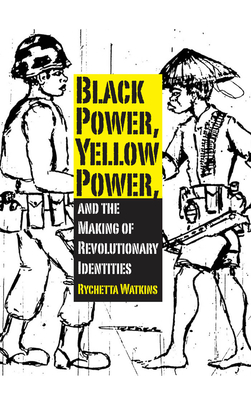
Black Power, Yellow Power, and the Making of Revolutionary Identities - Paperback
$38.99
Quantity
01
Pay over time for orders over $35.00 with
Offers & Perks
Earn 38 points with this purchase
Added to your rewards balance after checkout.
100 points welcome bonus
Create an account and start with extra points.
Availability:In StockContributor:Rychetta WatkinsTheme:Chronological Period/20th Century, Ethnic Orientation/African American, Ethnic Orientation/Asian, Ethnic Orientation/MulticulturalPublish date:10/4/2013Pages:176
Languages:EnglishPublisher:University Press of MississippiISBN-13:9781617039485ISBN-10:1617039489UPC:9781617039485Book Category:Social Science, Political ScienceBook Subcategory:Cultural & Ethnic Studies, Civil RightsBook Topic:African American & Black Studies, Asian American & Pacific Islander StudiesSize:8.50 x 5.50 x 0.46 inchesWeight:0.259Product ID:SC5DRZ45S7
Images of upraised fists, afros, and dashikis have long dominated the collective memory of Black Power and its proponents. The "guerilla" figure--taking the form of the black-leather-clad revolutionary within the Black Panther Party--has become an iconic trope in American popular culture. That politically radical figure, however, has been shaped as much by Asian American cultural discourse as by African American political ideology. From the Asian-African Conference held in April of 1955 in Bandung, Indonesia, onward to the present, Afro-Asian political collaboration has been active and influential. In Black Power, Yellow Power, and the Making of Revolutionary Identities, author Rychetta Watkins uses the guerilla figure as a point of departure and shows how the trope's rhetoric animates discourses of representation and identity in African American and Asian American literature and culture. In doing so, she examines the notion of "Power," in terms of ethnic political identity, and explores collaborating--and sometimes competing-- ethnic interests that have drawn ideas from the concept. The project brings together a range of texts--editorial cartoons, newspaper articles, novels, visual propaganda, and essays--that illustrate the emergence of this subjectivity in Asian American and African American cultural productions during the Power period, roughly 1966 through 1981. After a case study of the cultural politics of academic anthologies and the cooperation between Frank Chin and Ishmael Reed, the volume culminates with analyses of this trope in Sam Greenlee's The Spook Who Sat by the Door, Alice Walker's Meridian, and John Okada's No No Boy. Rychetta Watkins, Memphis, Tennessee, is assistant professor of English at Rhodes College. Her work has appeared in M/MLA Journal, MELUS, and the Southern Quarterly.
Languages:EnglishPublisher:University Press of MississippiISBN-13:9781617039485ISBN-10:1617039489UPC:9781617039485Book Category:Social Science, Political ScienceBook Subcategory:Cultural & Ethnic Studies, Civil RightsBook Topic:African American & Black Studies, Asian American & Pacific Islander StudiesSize:8.50 x 5.50 x 0.46 inchesWeight:0.259Product ID:SC5DRZ45S7
Rychetta Watkins is assistant professor of English at Rhodes College. Her work has appeared in M/MLA Journal, MELUS, and the Southern Quarterly.
Publisher: University Press of Mississippi
Contributor(s)
Author
Free shipping on orders over $75. Standard shipping takes 3-7 business days. Eligible items may be returned within 30 days of delivery. Conditions apply.