
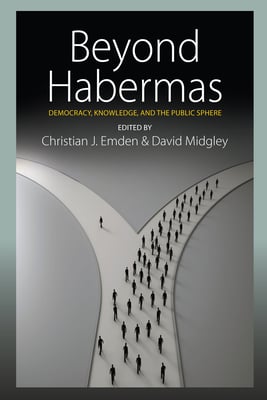
Beyond Habermas: Democracy, Knowledge, and the Public Sphere - Paperback
Pay over time for orders over $35.00 with
Offers & Perks
Earn 36 points with this purchase
Added to your rewards balance after checkout.
100 points welcome bonus
Create an account and start with extra points.
During the 1960s the German philosopher Jürgen Habermas introduced the notion of a "bourgeois public sphere" in order to describe the symbolic arena of political life and conversation that originated with the cultural institutions of the early eighteenth-century; since then the "public sphere" itself has become perhaps one of the most debated concepts at the very heart of modernity. For Habermas, the tension between the administrative power of the state, with its understanding of sovereignty, and the emerging institutions of the bourgeoisie--coffee houses, periodicals, encyclopedias, literary culture, etc.--was seen as being mediated by the public sphere, making it a symbolic site of public reasoning. This volume examines whether the "public sphere" remains a central explanatory model in the social sciences, political theory, and the humanities.
Christian J. Emden is Professor of German Intellectual History and Political Thought at Rice University. He is the author of Nietzsche on Language, Consciousness, and the Body (University of Illinois Press, 2005) and Friedrich Nietzsche and the Politics of History (Cambridge University Press, 2008).
Midgley, David: -David Midgley is Professor in German Literature and Culture at the University of Cambridge, England, and a Fellow of St. John's College. His publications include WritingWeimar: Critical Realismin German Literature, 1918-1933 (Oxford University Press, 2000).
Contributor(s)
Free shipping on orders over $75. Standard shipping takes 3-7 business days. Eligible items may be returned within 30 days of delivery. Conditions apply.