
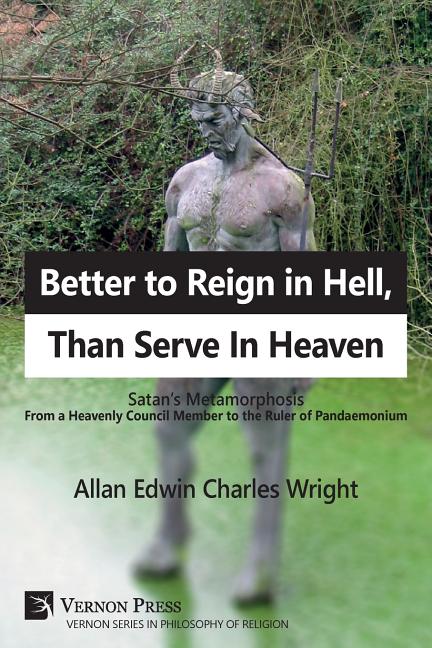
Better to Reign in Hell, Than Serve In Heaven: Satan's Metamorphosis From a Heavenly Council Member to the Ruler of Pandaemonium - Paperback
Choose Option
Paperback

Hardcover
Pay over time for orders over $35.00 with
Offers & Perks
Earn 55 points with this purchase
Added to your rewards balance after checkout.
100 points welcome bonus
Create an account and start with extra points.
In this monograph, I argue that Satan was not perceived as a universal malevolent deity, the embodiment of evil, or the "ruler of Pandaemonium" within first century Christian literature or even within second and third century Christian discourses as some scholars have insisted. Instead, for early "Christian" authors, Satan represented a pejorative term used to describe terrestrial, tangible, and concrete social realities, perceived of as adversaries. To reach this conclusion, I explore the narrative character of Satan selectively within the Hebrew Bible, intertestamental literature, Mark, Matthew, Luke, Q, the Book of Revelation, the Nag Hammadi texts, and the Ante-Nicene fathers.
I argue that certain scholars' such as Jeffrey Burton Russell, Miguel A. De La Torre, Albert Hernandez, Peter Stanford, Paul Carus, and Gerd Theissen, homogenized reconstructions of the "New Testament Satan" as the universalized incarnation of evil and that God's absolute cosmic enemy is absent from early Christian orthodox literature, such as Mark, Matthew, Luke, Q, the Book of Revelation, and certain writings from the Ante-Nicene Fathers. Using Jonathan Z. Smith's essay Here, There, and Anywhere, I suggest that the cosmic dualist approach to Satan as God's absolute cosmic enemy resulted from the changing social topography of the early fourth century where Christian "insider" and "outsider" adversaries were diminishing. With these threats fading, early Christians universalized a perceived chaotic cosmic enemy, namely Satan, being influenced by the Gnostic demiurge, who disrupts God's terrestrial and cosmic order. Therefore, Satan transitioned from a "here," "insider," and "there," "outsider," threat to a universal "anywhere" threat. This study could be employed as a characterization study, New Testament theory and application for classroom references or research purposes.
Contributor(s)
Free shipping on orders over $75. Standard shipping takes 3-7 business days. Eligible items may be returned within 30 days of delivery. Conditions apply.