
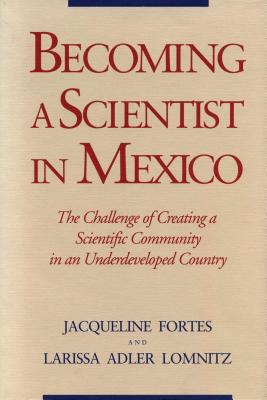
Becoming a Scientist in Mexico: The Challenge of Creating a Scientific Community in an Underdeveloped Country - Paperback
Pay over time for orders over $35.00 with
Offers & Perks
Earn 52 points with this purchase
Added to your rewards balance after checkout.
100 points welcome bonus
Create an account and start with extra points.
Mexico is a developing society that only recently has begun to fully appreciate the importance of technology to economic success. It has had no clear vision of what the role of science is of how a scientific community can be formed. Understandably, in these circumstances, careers in science still do not have the status and recognition that such professions as medicine, engineering, and law have traditionally enjoyed.
A program to train students in biomedical research was launches at the National Autonomous University of Mexico (UNAM) in the early 1980s as an experiment in providing the conditions necessary for fostering the growth of a scientific community in Mexico, where teaching and research have hitherto been institutionally separated. The authors, drawing on the methods and insights of anthropology, psychology, and sociology, observed the process through which the first two cohorts of students went in their training to become research scientists, in interaction with both their professors and their peers.
What this study shows is that, while the learning of specialized knowledge and techniques are necessary for becoming a scientist, they are not sufficient: the role of beliefs and values is crucial. The authors therefore focus attention on the ethos of science, the ideal model underlying the process of socialization--how it was transmitted to the students and how they assimilated it.
Their findings will be of interest to all scholars studying the relationships of science, technology, and society, especially those concerned about the special challenges underdeveloped countries face in integrating themselves into the worldwide scientific community.
Jacqueline Fortes is a social psychologist who is currently President of the Institute of the Family in Mexico City.
Larissa Adler Lomnitz is an anthropologist who is affiliated with the Institute of Applied Mathematics at UNAM and is co-author of A Mexican Family, 1820-1980: Kinship, Class, and Culture (1988).
Contributor(s)
Authors
Free shipping on orders over $75. Standard shipping takes 3-7 business days. Returns accepted within 30 days of purchase.