
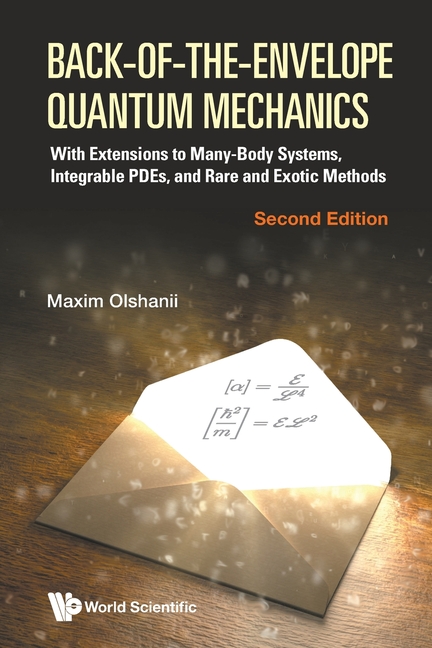
Back-Envelope Quant Mech (2nd Ed) - Paperback
Choose Option
Paperback

Back-Envelope Quant Mech (2nd Ed)
Pay over time for orders over $35.00 with
Offers & Perks
Earn 47 points with this purchase
Added to your rewards balance after checkout.
100 points welcome bonus
Create an account and start with extra points.
Dimensional and order-of-magnitude estimates are practiced by almost everybody but taught almost nowhere. When physics students engage in their first theoretical research project, they soon learn that exactly solvable problems belong only to textbooks, that numerical models are long and resource consuming, and that "something else" is needed to quickly gain insight into the system they are going to study. Qualitative methods are this "something else", but typically, students have never heard of them before.
The aim of this book is to teach the craft of qualitative analysis using a set of problems, some with solutions and some without, in advanced undergraduate and beginning graduate Quantum Mechanics. Examples include a dimensional analysis solution for the spectrum of a quartic oscillator, simple WKB formulas for the matrix elements of a coordinate in a gravitational well, and a three-line-long estimate for the ionization energy of atoms uniformly valid across the whole periodic table. The pièce de résistance in the collection is a series of dimensional analysis questions in Integrable Nonlinear Partial Differential Equations with no dimensions existing a priori. Solved problems include the relationship between the size and the speed of solitons of the Korteweg-de Vries equation and an expression for the oscillation period of a Nonlinear Schrödinger breather as a function of its width.
A new theme that appears in the second edition are the rare and exotic methods in elementary quantum mechanics. The new chapter covers quantum-mechanical supersymmetry, power index method, scale invariance, self-similarity, and circle inversion.
Free shipping on orders over $75. Standard shipping takes 3-7 business days. Eligible items may be returned within 30 days of delivery. Conditions apply.