
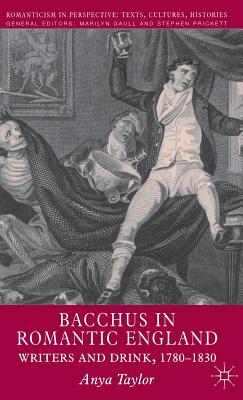
Bacchus in Romantic England: Writers and Drink 1780-1830 - Hardcover
by A. Taylor
$108.99
$109.99
-1%Quantity
01
Pay over time for orders over $35.00 with
Offers & Perks
Earn 108 points with this purchase
Added to your rewards balance after checkout.
100 points welcome bonus
Create an account and start with extra points.
Availability:In StockContributor:A. TaylorSeries:Romanticism in Perspective: Texts, Cultures, HistoriesTheme:Chronological Period/1800-1850, Chronological Period/19th Century, Chronological Period/Modern, Cultural Region/BritishPublish date:11/11/1998Pages:264
Languages:EnglishPublisher:Palgrave MacMillanISBN-13:9780333725214ISBN-10:0333725212UPC:9780333725214Book Category:Literary CriticismBook Subcategory:English, Irish, Scottish, Welsh, Poetry, ModernSize:8.50 x 5.50 x 0.69 inchesWeight:0.477Product ID:SC7R2NF7TZ
Bacchus in Romantic England describes real drunkenness among writers and ordinary people in the Romantic age. It grounds this 'reality' in writings by doctors and philanthropists from 1780 onwards, who describe an epidemic of drunkenness. These commentators provide a context for the different ways that poets and novelists of the age represent drunkards. Wordsworth writes poems and essays evaluating the drunken career of his model Robert Burns. Charles Lamb's essays and letters reveal a real and metaphorical preoccupation with his own drinking as a way of disguising his personal suffering; his companion Coleridge writes drinking songs, essays about drunkenness, and meditations about his own weakness of will that show both festive inebriety and consciousness of an inward abyss; Coleridge's son Hartley, whose fate his father had prophesied, experiences drunkenness as the life-long humiliation described in his poems and letters. Keats's complex dionysianism runs through 'Endymion' and the late odes, setting him at odds with his temperate hero Milton. Men in the Romantic age, such as Sheridan, Byron, Moor, and Clare, celebrate rowdy friendship with tales and songs of drinking; Romantic women novelists such as Smith, Edgeworth and Wollstonecraft depict these men stumbling home to abuse their wives. Although excessive drinking is real in the period, observers and participants can still maintain ambivalence about its power to release or to debase the human being.
Languages:EnglishPublisher:Palgrave MacMillanISBN-13:9780333725214ISBN-10:0333725212UPC:9780333725214Book Category:Literary CriticismBook Subcategory:English, Irish, Scottish, Welsh, Poetry, ModernSize:8.50 x 5.50 x 0.69 inchesWeight:0.477Product ID:SC7R2NF7TZ
ANYA TAYLOR is Professor of English at John Jay College of Criminal Justice, The City University of New York, where she also teaches in the Alcohol and Substance Abuse Program. She is the author of Magic in English Romanticism (1979), Coleridge's Defence of the Human (1986), Coleridge: On Humanity (1994), and many articles on Romantic and modern writers, and on addictions.
Publisher: Palgrave MacMillan
Edition
1999 Edition
Free shipping on orders over $75. Standard shipping takes 3-7 business days. Eligible items may be returned within 30 days of delivery. Conditions apply.