
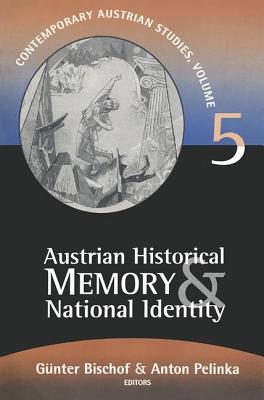
Austrian Historical Memory and National Identity - Paperback
Pay over time for orders over $35.00 with
Offers & Perks
Earn 70 points with this purchase
Added to your rewards balance after checkout.
100 points welcome bonus
Create an account and start with extra points.
When the Hapsburg monarchy disintegrated after World War I, Austria was not considered to be a viable entity. In a vacuum of national identity the hapless country drifted toward a larger Germany. After World War II, Austrian elites constructed a new identity based on being a "victim" of Nazi Germany. Cold war Austria, however, envisioned herself as a neutral "island of the blessed" between and separate from both superpower blocs. Now, with her membership in the European Union secured, Austria is reconstructing her painful historical memory and national identity. In 1996 she celebrates her 1000-year anniversary.
In this volume of Contemporary Austrian Studies, Franz Mathis and Brigitte Mazohl-Wallnig argue that regional identities in Austria have deeper historical roots than the many artificial and ineffective attempts to construct a national identity. Heidemarie Uhl, Anton Pelinka, and Brigitte Bailer discuss the post-World War II construction of the victim mythology. Robert Herzstein analyses the crucial impact of the 1986 Waldheim election imploding Austria's comforting historical memory as a "nation of victims." Wolfram Kaiser shows Austria's difficult adjustments to the European Union and the larger challenges of constructing a new "European identity." Chad Berry's analysis of American World War II memory establishes a useful counterpoint to construction of historical memory in a different national context.
A special forum on Austrian intelligence studies presents a fascinating reconstruction by Timothy Naftali of the investigation by Anglo-American counterintelligence into the retreat of Hitler's troops into the Alps during World War II. Rudiger Overmans' "research note" presents statistics on lower death rates of Austrian soldiers in the German army. Review essays by Gunther Kronenbitter and Gunter Bischof, book reviews, and a 1995 survey of Austrian politics round out the volume. Austrian Historical Memory and National Identity will be of intense interest to foreign policy analysts, historians, and scholars concerned with the unique elements of identity and nationality in Central European politics.
Anton Pelinka was professor of political science at the University of Innsbruck (1975-2006). Since 2006 he is professor of nationalism studies and political science at the Central European University, Budapest. He has written extensively in the field of comparative European politics and democratic theory.
Bischof, Gunter: -GUnter Bischof is the Marshall Plan Professor of History and director of Center Austria at the University of New Orleans.
Contributor(s)
Author
Free shipping on orders over $75. Standard shipping takes 3-7 business days. Eligible items may be returned within 30 days of delivery. Conditions apply.