
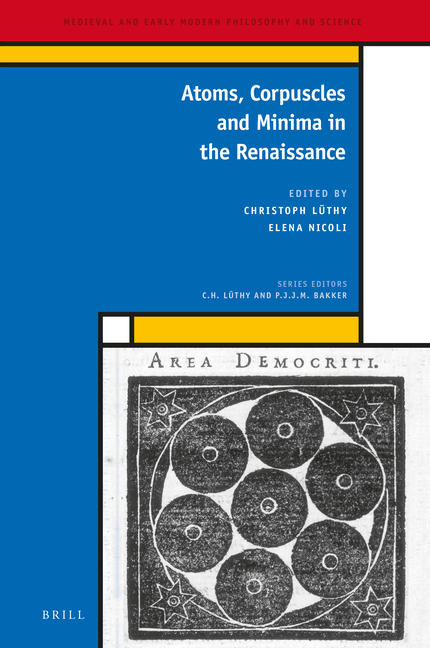
Atoms, Corpuscles and Minima in the Renaissance - Hardcover
$205.99
Quantity
01
Pay over time for orders over $35.00 with
Offers & Perks
Earn 205 points with this purchase
Added to your rewards balance after checkout.
100 points welcome bonus
Create an account and start with extra points.
Availability:In StockContributor:Elena NicoliSeries:Medieval and Early Modern Philosophy and ScienceTheme:Chronological Period/Medieval (500-1453) StudiesPublish date:11/3/2022Pages:322
Languages:EnglishPublisher:BrillISBN-13:9789004528918ISBN-10:9004528911UPC:9789004528918Book Category:Science, History, PhilosophyBook Subcategory:History, Europe, History & SurveysBook Topic:Renaissance, MedievalSize:9.21 x 6.10 x 0.75 inchesWeight:0.636Product ID:SC1TH0DP7J
The Renaissance witnessed an upsurge in explanations of natural events in terms of invisibly small particles - atoms, corpuscles, minima, monads and particles. The reasons for this development are as varied as are the entities that were proposed. This volume covers the period from the earliest commentaries on Lucretius' De rerum natura to the sources of Newton's alchemical texts. Contributors examine key developments in Renaissance physiology, meteorology, metaphysics, theology, chymistry and historiography, all of which came to assign a greater explanatory weight to minute entities. These contributions show that there was no simple 'revival of atomism', but that the Renaissance confronts us with a diverse and conceptually messy process. Contributors are: Stephen Clucas, Christoph Lüthy, Craig Martin, Elisabeth Moreau, William R. Newman, Elena Nicoli, Sandra Plastina, Kuni Sakamoto, Jole Shackelford, and Leen Spruit.
Languages:EnglishPublisher:BrillISBN-13:9789004528918ISBN-10:9004528911UPC:9789004528918Book Category:Science, History, PhilosophyBook Subcategory:History, Europe, History & SurveysBook Topic:Renaissance, MedievalSize:9.21 x 6.10 x 0.75 inchesWeight:0.636Product ID:SC1TH0DP7J
Christoph Lüthy, Ph.D. (1995) is Professor of the History of Philosophy and Science at Radboud University, Nijmegen (The Netherlands). His publications concern mainly the history of matter theories and the development and logic of 'epistemic images'.
Elena Nicoli, Ph.D. (2017) is an Associate Researcher at the Center for the History of Philosophy and Science at Radboud University, Nijmegen (The Netherlands). Her research and publications mainly concern the reception of Lucretius and Epicureanism in the Renaissance.
Elena Nicoli, Ph.D. (2017) is an Associate Researcher at the Center for the History of Philosophy and Science at Radboud University, Nijmegen (The Netherlands). Her research and publications mainly concern the reception of Lucretius and Epicureanism in the Renaissance.
Publisher: Brill
Contributor(s)
Free shipping on orders over $75. Standard shipping takes 3-7 business days. Returns accepted within 30 days of purchase.