
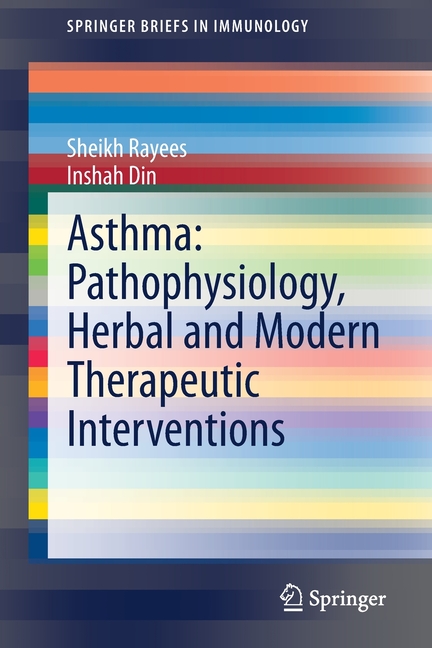
Asthma: Pathophysiology, Herbal and Modern Therapeutic Interventions - Paperback
$69.99
Quantity
01
Pay over time for orders over $35.00 with
Offers & Perks
Earn 69 points with this purchase
Added to your rewards balance after checkout.
100 points welcome bonus
Create an account and start with extra points.
Availability:In StockContributor:Sheikh Rayees, Inshah DinSeries:Springerbriefs in ImmunologyPublish date:3/27/2021Pages:69
Languages:EnglishPublisher:SpringerISBN-13:9783030702694ISBN-10:3030702693UPC:9783030702694Book Category:Medical, ScienceBook Subcategory:Pulmonary & Thoracic Medicine, Life Sciences, Alternative & Complementary MedicineBook Topic:BiochemistrySize:9.21 x 6.14 x 0.17 inchesWeight:0.123Product ID:SC12FHJ1NH
Asthma is a chronic airway disease affecting over 300 million people worldwide with an expected increase of an additional 100 million by 2025. Past decade has observed a notable increase in asthma prevalence on both national and global levels with highest rates observed in western countries (about 30%). Over the past 40 years, a drastic increase in global prevalence, morbidity, mortality, and economic burden have been observed due to asthma especially in children. The rising numbers of hospital admissions for asthma, especially young children, reflect an increase in severe asthma, poverty and lack of proper disease management. Worldwide, approximately 180,000 deaths annually are caused due to this condition. The financial burden on a single asthma patient per year in different western countries ranges from US$300-1,300.
Asthma is an intricate respiratory disorder with differences in its severity, natural history and hence treatment response. These differences in intensities of various presentations such as bronchial hyper-responsiveness, airway inflammation, mucus production, airflow obstruction make asthma a heterogeneous disease. The mainstay of current therapies for asthma includes inhaled corticosteroids, phosphodiesterase inhibitors, leukotriene modifiers and β2-adrenoceptor agonists. Some of the currently available drugs are efficient in one or more aspects. However the associated side effects or heterogeneity of the disease limit their usefulness and efficacy, thereby putting a demand on development of new drugs and therapies. On the other hand, asthma has also been treated/managed via herbal medications. These approaches have been described in Unani, Ayurvedic or Chinese system of medicine since antiquity. In fact, several anti-asthmatic drugs were developed from herbs commonly utilized in the non-Western system of medicine.
This book focuses on the pathophysiology of asthma, its medication (both herbal and modern), limitations and their future prospects.
Asthma is an intricate respiratory disorder with differences in its severity, natural history and hence treatment response. These differences in intensities of various presentations such as bronchial hyper-responsiveness, airway inflammation, mucus production, airflow obstruction make asthma a heterogeneous disease. The mainstay of current therapies for asthma includes inhaled corticosteroids, phosphodiesterase inhibitors, leukotriene modifiers and β2-adrenoceptor agonists. Some of the currently available drugs are efficient in one or more aspects. However the associated side effects or heterogeneity of the disease limit their usefulness and efficacy, thereby putting a demand on development of new drugs and therapies. On the other hand, asthma has also been treated/managed via herbal medications. These approaches have been described in Unani, Ayurvedic or Chinese system of medicine since antiquity. In fact, several anti-asthmatic drugs were developed from herbs commonly utilized in the non-Western system of medicine.
This book focuses on the pathophysiology of asthma, its medication (both herbal and modern), limitations and their future prospects.
Languages:EnglishPublisher:SpringerISBN-13:9783030702694ISBN-10:3030702693UPC:9783030702694Book Category:Medical, ScienceBook Subcategory:Pulmonary & Thoracic Medicine, Life Sciences, Alternative & Complementary MedicineBook Topic:BiochemistrySize:9.21 x 6.14 x 0.17 inchesWeight:0.123Product ID:SC12FHJ1NH
Dr Rayees Sheikh is a postdoctoral research associate at the University of Illinois at Chicago. His research focuses on the inflammation signaling mechanisms of lung diseases. He was recently awarded prestigious Ramalingaswami Fellowship by Department of Biotechnology, Government of India. He has published extensively in international peer-reviewed journals as well as contributed book chapters on plant-based therapeutics for human disorders.
Dr Inshah Din is a research scholar at Government Medical College at Srinagar, India. She also worked as a Junior Reseach Fellow at the prestigious Sher-i-Kashmir Institute of Medical Sciences, and has published primary research articles and book chapters with international publishing houses. Her clinical research evaluates the possible connection between diabetes development via the adipokine and vitamin D axis. Her other work studies the efficacy of herbal medicine on chronic human conditions.
Dr Inshah Din is a research scholar at Government Medical College at Srinagar, India. She also worked as a Junior Reseach Fellow at the prestigious Sher-i-Kashmir Institute of Medical Sciences, and has published primary research articles and book chapters with international publishing houses. Her clinical research evaluates the possible connection between diabetes development via the adipokine and vitamin D axis. Her other work studies the efficacy of herbal medicine on chronic human conditions.
Publisher: Springer
Edition
2021 Edition
Contributor(s)
Authors
Free shipping on orders over $75. Standard shipping takes 3-7 business days. Returns accepted within 30 days of purchase.