
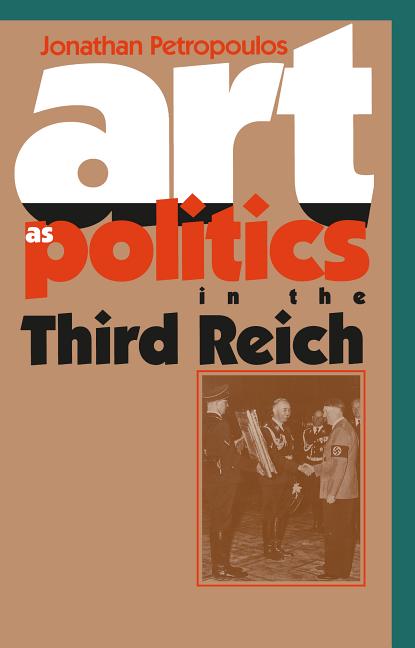
Art as Politics in the Third Reich - Paperback
$47.99
Quantity
01
Pay over time for orders over $35.00 with
Offers & Perks
Earn 47 points with this purchase
Added to your rewards balance after checkout.
100 points welcome bonus
Create an account and start with extra points.
Availability:In StockContributor:Jonathan PetropoulosTheme:Chronological Period/1930's, Chronological Period/1940's, Cultural Region/Germany, Ethnic Orientation/GermanPublish date:2/22/1999Pages:464
The political elite of Nazi Germany perceived itself as a cultural elite as well. In Art as Politics in the Third Reich, Jonathan Petropoulos explores the elite's cultural aspirations by examining both the formulation of a national aesthetic policy and the content of the private art collections held by high-ranking Nazis. He demonstrates that these leaders manipulated public policy and their own collecting patterns to articulate fundamental tenets of Nazi ideology.
Petropoulos begins by tracing the evolution of official aesthetic policy, from the purges of museum staff and academics labeled as 'undesirable' in 1933 to the confiscation of Jewish-owned artworks in the late 1930s and the organized plundering of art from occupied areas during the war. He then reconstructs the collections of a dozen prominent Nazi officials -- including Hitler, Göring, Goebbels, Himmler, Speer, and Ribbentrop -- and argues that their private holdings defined their relationships to one another within the Nazi hierarchy in addition to reflecting their racist and nationalist beliefs. According to Petropoulos, art collecting offered the political elite a way to achieve legitimacy and social standing, thereby providing a common cultural language for the leaders of the Third Reich.
Petropoulos begins by tracing the evolution of official aesthetic policy, from the purges of museum staff and academics labeled as 'undesirable' in 1933 to the confiscation of Jewish-owned artworks in the late 1930s and the organized plundering of art from occupied areas during the war. He then reconstructs the collections of a dozen prominent Nazi officials -- including Hitler, Göring, Goebbels, Himmler, Speer, and Ribbentrop -- and argues that their private holdings defined their relationships to one another within the Nazi hierarchy in addition to reflecting their racist and nationalist beliefs. According to Petropoulos, art collecting offered the political elite a way to achieve legitimacy and social standing, thereby providing a common cultural language for the leaders of the Third Reich.
Petropoulos, Jonathan: - Jonathan Petropoulos is John V. Croul Professor of European History at Claremont McKenna College in Claremont, California.
Publisher: University of North Carolina Press
Edition
Revised Edition
Contributor(s)
Author
Free shipping on orders over $75. Standard shipping takes 3-7 business days. Eligible items may be returned within 30 days of delivery. Conditions apply.