
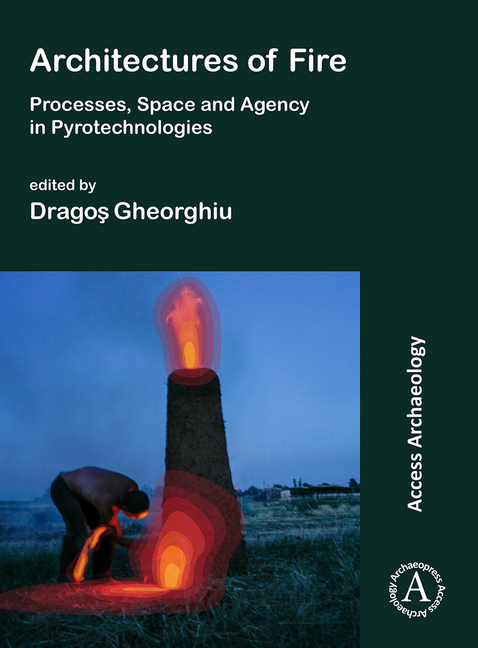
Architectures of Fire: Processes, Space and Agency in Pyrotechnologies - Paperback
$46.99
Quantity
01
Pay over time for orders over $35.00 with
Offers & Perks
Earn 46 points with this purchase
Added to your rewards balance after checkout.
100 points welcome bonus
Create an account and start with extra points.
Availability:In StockContributor:Dragos GheorghiuTheme:Chronological Period/Ancient (To 499 A.D.)Publish date:10/24/2019Pages:108
Languages:EnglishPublisher:Archaeopress PublishingISBN-13:9781789693676ISBN-10:1789693675UPC:9781789693676Book Category:Social Science, HistoryBook Subcategory:Anthropology, Archaeology, EuropeSize:11.30 x 8.10 x 0.20 inchesWeight:0.363Product ID:SCF3MEF8CH
Architectures of Fire attempts to present the entanglement between the physical phenomenon of fire, the pyro-technological instrument that it is, its material supports, and the human being. In this perspective, the physical process of combustion, material culture, as well as the development of human action in space, are addressed together. Fire is located at the centre of all pre-modern architecture. It creates the living or technological space. Fire creates architectures since it imposes geometry, from the simple circles of stone or clay, which control its spread (and which are the geometrical figures of its optimal efficiency), to cone trunks, cylinders, half-spheres, half-cylinders or parallelepipeds, circular geometric figures that efficiently control the air-draught process required for combustion. All these forms involving the circle are determined by the control and conservation of thermal energy. We should not imagine that the term 'architecture' evokes only constructed objects that delimit human action. Architecture means not only the built space, but also the experienced space, in the present case around the pyro-instruments. Pyro-instruments involve an ergonomic, kinesthetic and visual relationship, as well as the rhythmic actions of feeding or maintaining fire at a certain technological tempo. The technological agency is structured both by the physics of the combustion phenomenon, and by the type of operation to be performed.
Languages:EnglishPublisher:Archaeopress PublishingISBN-13:9781789693676ISBN-10:1789693675UPC:9781789693676Book Category:Social Science, HistoryBook Subcategory:Anthropology, Archaeology, EuropeSize:11.30 x 8.10 x 0.20 inchesWeight:0.363Product ID:SCF3MEF8CH
Gheorghiu, Dragos: - Dragos Gheorghiu is a historical anthropologist/archaeologist and experimentalist whose studies focus on the process of cognition, material culture, ancient technologies, and iconography. Professor Gheorghiu has edited books on anthropomorphic and zoomorphic figurines, fire in archaeology, fire as an instrument, early ceramic traditions, metaphorical thought, experientiality and imagination in archaeology. During the last two decades he carried out large scale experiments of art and archaeology. Vincent C. Paladino is a cognitive anthropologist/archaeologist and educator who specializes in the study of audiovisual technologies, cyber environments, and feedback systems, which he terms anthrocyberism. His research focuses on the effect of these modern technologies on human cognition and behavior. His research interests include archaeoacoustics, investigating the role of sound in ancient contexts and its connection to cognitive processes and learning in both historical and contemporary settings.
Publisher: Archaeopress Publishing
Contributor(s)
Free shipping on orders over $75. Standard shipping takes 3-7 business days. Eligible items may be returned within 30 days of delivery. Conditions apply.