
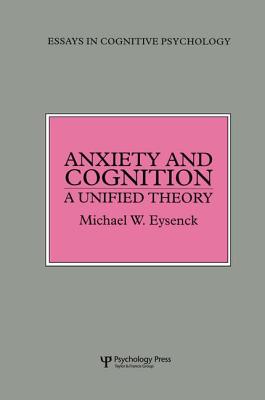
Anxiety and Cognition: A Unified Theory - Paperback
Pay over time for orders over $35.00 with
Offers & Perks
Earn 76 points with this purchase
Added to your rewards balance after checkout.
100 points welcome bonus
Create an account and start with extra points.
It is argued in this book that there are three major approaches to anxiety. First, there is anxiety as an emotional state. Second, there is trait anxiety as a dimension of personality. Third, there is anxiety as a set of anxiety disorders. What is attempted is to produce a unified theory of anxiety which integrates all these major approaches. According to this unified theory, there are four sources of information which influence the level of experienced anxiety: (1) experimental stimulation; (2) internal physiological activity; (3) internal cognitions, (e.g., worries); and (4) one's own behaviour. The unified theory is essentially based on a cognitive approach. More specifically, it is assumed that individual differences in experienced anxiety between those high and low in trait anxiety depend largely on cognitive biases. It is also assumed that the various anxiety disorders depend on cognitive biases, and that the main anxiety disorders differ in terms of the source of information most affected by such biases (e.g., social phobics have biased interpretation of their own behaviour). In sum, this book presents a general theory of anxiety from the cognitive perspective. It is intended that this theory will influence theory and research on emotion, personality, and the anxiety disorders.
Correction notice: Christos Halkiopoulos should have been credited for his role as the inventor of the Dot Probe Paradigm and for the design and execution of the experiment discussed in C. D. Spielberger, I. G. Sarason, Z. Kulczar, and J. Van Heck (Eds.), Stress and Emotion, Vol. 14. London: Hemisphere.
Free shipping on orders over $75. Standard shipping takes 3-7 business days. Returns accepted within 30 days of purchase.