
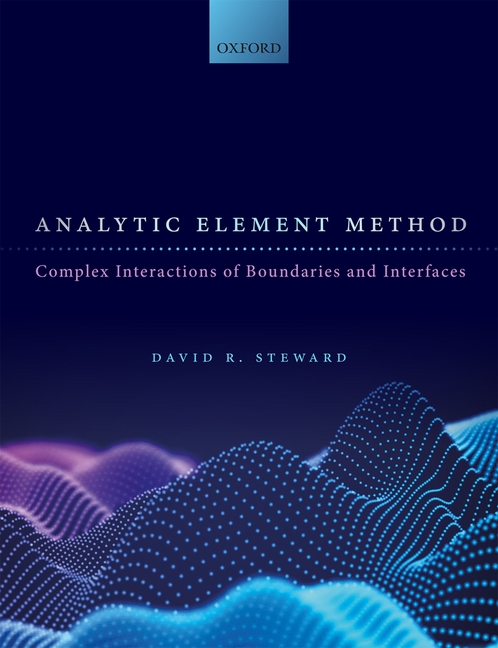
Analytic Element Method: Complex Interactions of Boundaries and Interfaces - Hardcover
$135.99
Quantity
01
Pay over time for orders over $35.00 with
Offers & Perks
Earn 135 points with this purchase
Added to your rewards balance after checkout.
100 points welcome bonus
Create an account and start with extra points.
Languages:EnglishPublisher:Oxford University PressISBN-13:9780198856788ISBN-10:0198856784UPC:9780198856788Book Category:Nature, Mathematics, ScienceBook Subcategory:Rocks & Minerals, Applied, PhysicsSize:9.80 x 7.60 x 0.90 inchesWeight:0.84Product ID:SCN8XPA851
"Analytic Element Method" (AEM) assembles a broad range of mathematical and computational approaches to solve important problems in engineering and science. As the subtitle "Complex Interactions of Boundaries and Interfaces" suggests, problems are partitioned into sets of elements and methods are formulated to solve conditions along their boundaries and interfaces. Presentation will place an element within its landscape, formulate its interactions with other elements using linear series of influence functions, and then solve for its coefficients to match its boundary and interface conditions. Computational methods enable boundary and interface conditions of closely interacting elements to be matched with nearly exact precision, commonly to within 8-12 significant digits. Comprehensive solutions provide elements that collectively interact and shape the environment within which they exist. This work is grounded in a wide range of foundational studies, using exact solutions for important boundary value problems. However, the computational capacity of their times limited solutions to idealized problems, commonly involving a single isolated element within a uniform regional background. With the advent of modern computers, such mathematically based methods were passed over by many, in the pursuit of discretized domain solutions using finite element and finite difference methods. Yet, the elegance of the mathematical foundational studies remains, and the rationale for the Analytic Element Method was inspired by the realization that computational advances could also lead to advances in the mathematical methods that were unforeseeable in the past.
Languages:EnglishPublisher:Oxford University PressISBN-13:9780198856788ISBN-10:0198856784UPC:9780198856788Book Category:Nature, Mathematics, ScienceBook Subcategory:Rocks & Minerals, Applied, PhysicsSize:9.80 x 7.60 x 0.90 inchesWeight:0.84Product ID:SCN8XPA851
David R. Steward, Professor and Chair, Department of Civil and Environmental Engineering, North Dakota State University Professor David R. Steward is chair of the Department of Civil and Environmental Engineering at North Dakota State University and holds the Walter B. Booth Distinguished Professorship. Dr. Steward teaches courses in groundwater flow, water resources, hydraulics and engineering mathematics. He is licensed as a Professional Engineer (North Dakota and Minnesota) and a Professional Geoscientist (Texas), and is a Fellow of the American Society of Civil Engineers.
Publisher: Oxford University Press
Contributor(s)
Author
Free shipping on orders over $75. Standard shipping takes 3-7 business days. Eligible items may be returned within 30 days of delivery. Conditions apply.