
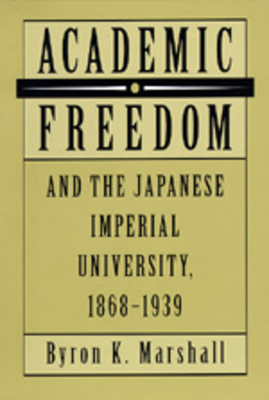
Academic Freedom and the Japanese Imperial University, 1868-1939 - Hardcover
$75.99
Quantity
01
Pay over time for orders over $35.00 with
Offers & Perks
Earn 75 points with this purchase
Added to your rewards balance after checkout.
100 points welcome bonus
Create an account and start with extra points.
Availability:In StockContributor:Byron K. MarshallTheme:Chronological Period/1851-1899, Chronological Period/1900-1949, Cultural Region/JapanesePublish date:12/28/1992Pages:264
Byron K. Marshall offers here a dramatic study of the changing nature and limits of academic freedom in prewar Japan, from the Meiji Restoration to the eve of World War II.
Meiji leaders founded Tokyo Imperial University in the late nineteenth century to provide their new government with necessary technical and theoretical knowledge. An academic elite, armed with Western learning, gradually emerged and wielded significant influence throughout the state. When some faculty members criticized the conduct of the Russo-Japanese War the government threatened dismissals. The faculty and administration banded together, forcing the government to back down. By 1939, however, this solidarity had eroded. The conventional explanation for this erosion has been the lack of a tradition of autonomy among prewar Japanese universities. Marshall argues instead that these later purges resulted from the university's 40-year fixation on institutional autonomy at the expense of academic freedom.
Marshall's finely nuanced analysis is complemented by extensive use of quantitative, biographical, and archival sources.
Meiji leaders founded Tokyo Imperial University in the late nineteenth century to provide their new government with necessary technical and theoretical knowledge. An academic elite, armed with Western learning, gradually emerged and wielded significant influence throughout the state. When some faculty members criticized the conduct of the Russo-Japanese War the government threatened dismissals. The faculty and administration banded together, forcing the government to back down. By 1939, however, this solidarity had eroded. The conventional explanation for this erosion has been the lack of a tradition of autonomy among prewar Japanese universities. Marshall argues instead that these later purges resulted from the university's 40-year fixation on institutional autonomy at the expense of academic freedom.
Marshall's finely nuanced analysis is complemented by extensive use of quantitative, biographical, and archival sources.
Byron K. Marshall is Professor of Japanese History at the University of Minnesota and the author of Capitalism and Nationalism in Prewar Japan: The Ideology of the Business Elite, 1868-1941 (1967).
Publisher: University of California Press
Contributor(s)
Author
Free shipping on orders over $75. Standard shipping takes 3-7 business days. Eligible items may be returned within 30 days of delivery. Conditions apply.