
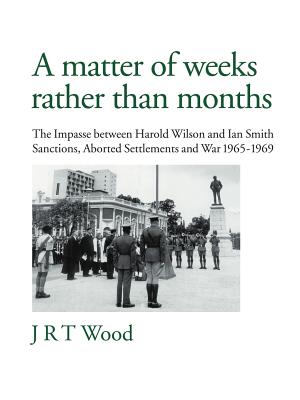
A Matter of Weeks Rather Than Months: The Impasse Between Harold Wilson and Ian Smith Sanctions, Aborted Settlements and War 1965-1969 - Paperback
$32.99
$34.30
-4%Quantity
01
Pay over time for orders over $35.00 with
Offers & Perks
Earn 32 points with this purchase
Added to your rewards balance after checkout.
100 points welcome bonus
Create an account and start with extra points.
Availability:In StockContributor:J. R. T. WoodTheme:Cultural Region/African, Cultural Region/Southern AfricaPublish date:7/31/2012Pages:772
Languages:EnglishPublisher:Trafford PublishingISBN-13:9781466934092ISBN-10:1466934093UPC:9781466934092Book Category:HistoryBook Subcategory:Africa, Wars & ConflictsBook Topic:SouthSize:11.00 x 8.25 x 1.54 inchesWeight:1.703Product ID:SCHA7CTKF5
Founded on 35 years of research into o the post-1945 Anglo-Rhodesian history, this book complements Richard Wood's The Welensky Papers: A History of the Federation of Rhodesia and Nyasaland: 1953-1963 (1983) and So Far and No Further! Rhodesia's bid for independence during the retreat from empire: 1959-1965 (2005). Of So Far, Michael Hartnack wrote that 'Once in a lifetime comes a book which must force a total shift in the thinking person's perception of an epoch, and of all the prominent characters who featured in it.' A Matter of Weeks Rather than Months recounts the action and reaction to Ian Smith's unilateral declaration of Rhodesia's independence, the second such declaration since the American one of 1776. It examines the dilemmas of both sides. Smith's problem was how to legitimise his rebellion to secure crucial investment capital, markets, trade and more. His antagonist, the British Prime Minister, Harold Wilson, was determined not to transfer sovereignty until Rhodesia accepted African majority rule in common with the rest of Africa. Given British feelings for their Rhodesian kith and kin and Rhodesia's landlocked position, Wilson eschewed the use of force. He could only impose sanctions but hoped they would defeat Smith 'in a matter weeks rather than months'. The Rhodesians, however, evaded the sanctions with such success that they forced Wilson to negotiate a settlement. Negotiations were nevertheless doomed because the self-confident Rhodesians would not accept a period of direct British rule while rapid progress to majority rule was made or the imposition of restraints on powers they had possessed since gaining self-government in 1923. In tune with their allies in the African National Congress of South Africa, the Rhodesian or Zimbabwean African nationalists had already adopted the Marxist concept of the 'Armed Struggle' as a means to power. Sponsored by the Communist Bloc, its surrogates and allies, they began a series of armed incursions from their safe haven in Zambia. Although bloodily and easily repulsed, they would learn from their mistakes as the Rhodesian forces would discover in the 1970s. Consequently, this is a tale of sanctions, negotiations and counter-insurgency warfare.
Languages:EnglishPublisher:Trafford PublishingISBN-13:9781466934092ISBN-10:1466934093UPC:9781466934092Book Category:HistoryBook Subcategory:Africa, Wars & ConflictsBook Topic:SouthSize:11.00 x 8.25 x 1.54 inchesWeight:1.703Product ID:SCHA7CTKF5
Free shipping on orders over $75. Standard shipping takes 3-7 business days. Returns accepted within 30 days of purchase.