
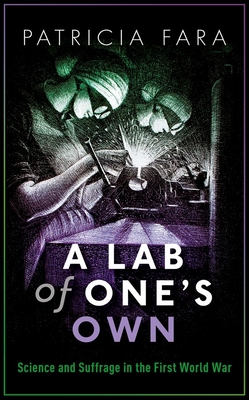
A Lab of One's Own: Science and Suffrage in the First World War - Hardcover
$25.99
$35.99
-28%Choose Option
Hardcover
$25.99
$35.99

Lab of One's Own: Science and Suffrage in the First World War
$11.99
$16.98
Quantity
01
Pay over time for orders over $35.00 with
Offers & Perks
Earn 25 points with this purchase
Added to your rewards balance after checkout.
100 points welcome bonus
Create an account and start with extra points.
Availability:In StockContributor:Patricia FaraTheme:Chronological Period/1900-1919, Sex & Gender/Feminine, Topical/Women's History, Topical/Women's InterestPublish date:3/1/2018Pages:352
Languages:EnglishPublisher:Oxford University PressISBN-13:9780198794981ISBN-10:0198794983UPC:9780198794981Book Category:History, ScienceBook Subcategory:Wars & Conflicts, Women, HistoryBook Topic:World War ISize:8.60 x 5.70 x 1.30 inchesWeight:0.499Product ID:SCHFB7YD41
Patricia Fara unearths the forgotten suffragists of World War I who bravely changed women's roles in the war and paved the way for today's female scientists. Many extraordinary female scientists, doctors, and engineers tasted independence and responsibility for the first time during the First World War. How did this happen? Patricia Fara reveals how suffragists including Virginia Woolf's sister, Ray Strachey, had already aligned themselves with scientific and technological progress, and that during the dark years of war they mobilized women to enter conventionally male domains such as science and medicine. Fara tells the stories of women including mental health pioneer Isabel Emslie, chemist Martha Whiteley, a co-inventor of tear gas, and botanist Helen Gwynne Vaughan. Women were carrying out vital research in many aspects of science, but could it last? Though suffragist Millicent Fawcett declared triumphantly that "the war revolutionized the industrial position of women. It found them serfs, and left them free," the truth was very different. Although women had helped the country to victory and won the vote for those over thirty, they had lost the battle for equality. Men returning from the Front reclaimed their jobs, and conventional hierarchies were re-established. Fara examines how the bravery of these pioneers, temporarily allowed into a closed world before the door slammed shut again, paved the way for today's women scientists.
Languages:EnglishPublisher:Oxford University PressISBN-13:9780198794981ISBN-10:0198794983UPC:9780198794981Book Category:History, ScienceBook Subcategory:Wars & Conflicts, Women, HistoryBook Topic:World War ISize:8.60 x 5.70 x 1.30 inchesWeight:0.499Product ID:SCHFB7YD41
Patricia Fara lectures in the history of science at Cambridge University, where she is a Fellow of Clare College. She is the President of the British Society for the History of Science (2016-18) and her prize-winning book, Science: A Four Thousand Year History (OUP, 2009), has been translated into nine languages. In addition to many academic publications, her popular works include Newton: The Making of Genius, An Entertainment for Angels, Sex, Botany and Empire, and more. An experienced public lecturer, Patricia Fara appears regularly in TV documentaries and radio programs such as In Our Time. She also contributes articles and reviews to many journals, including History Today, BBC History, New Scientist, Nature and the Times Literary Supplement.
Publisher: Oxford University Press
Contributor(s)
Author
Free shipping on orders over $75. Standard shipping takes 3-7 business days. Returns accepted within 30 days of purchase.