
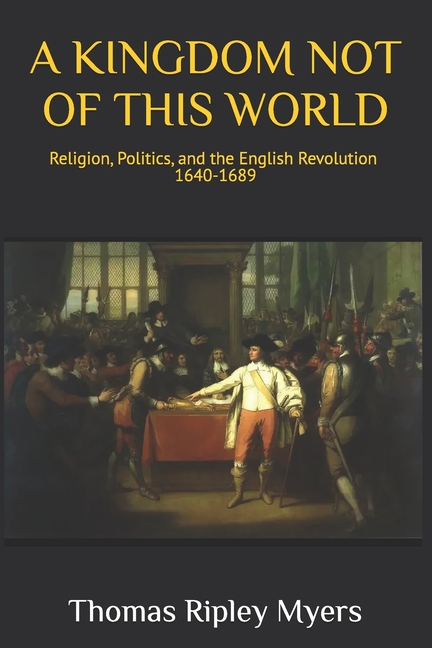
A Kingdom Not of This World: Religion, Politics, and the English Revolution 1640 -1689 - Paperback
$15.99
$18.00
-11%Quantity
01
Pay over time for orders over $35.00 with
Offers & Perks
Earn 15 points with this purchase
Added to your rewards balance after checkout.
100 points welcome bonus
Create an account and start with extra points.
Availability:In StockContributor:Thomas Ripley MyersTheme:Chronological Period/17th Century, Cultural Region/BritishPublish date:3/6/2026Pages:306
Languages:EnglishPublisher:Telos BooksISBN-13:9798994041208UPC:9798994041208Book Category:History, ReligionBook Subcategory:EuropeBook Topic:Great BritainSize:9.00 x 6.00 x 0.64 inchesWeight:0.413Product ID:SC1PVXFX16
When Conscience Went to War: Religion, Liberty, and England's Revolutionary Century
How theological disputes over bishops, prayers, and church government ignited civil war, regicide, and religious revolution and gave birth to liberty of conscience.
In 1642, England tore itself apart. King faced Parliament. Neighbor fought neighbor. By the time the guns fell silent, a king had been executed, military dictatorship had failed, and revolution had triumphed. The death toll: 200,000 in a nation of five million.
But this was no ordinary political conflict. It was a war over how to worship God.
Should churches be governed by bishops or elected elders? Should ministers read set prayers or speak extemporaneously? These questions sound arcane today. In 17th-century England, they were worth killing for, and worth dying for.
Four Visions Competed for England's Soul:
Dramatic Narrative Meets Deep Analysis:
Experience the period through vivid scenes:
The Settlement That Changed the World
By 1689, England had learned painful lessons: Religious uniformity couldn't be enforced. Conscience couldn't be coerced. Diversity was permanent, not temporary.
The Toleration Act satisfied no one but proved more durable than the perfect visions that preceded it. From England's failures came modern religious liberty, constitutional government, and denominational pluralism.
This is the story of how we got here, told with scholarly rigor but written for everyone who cares about freedom, faith, and the challenge of building societies where people with irreconcilable beliefs can live together. Perfect For:
How theological disputes over bishops, prayers, and church government ignited civil war, regicide, and religious revolution and gave birth to liberty of conscience.
In 1642, England tore itself apart. King faced Parliament. Neighbor fought neighbor. By the time the guns fell silent, a king had been executed, military dictatorship had failed, and revolution had triumphed. The death toll: 200,000 in a nation of five million.
But this was no ordinary political conflict. It was a war over how to worship God.
Should churches be governed by bishops or elected elders? Should ministers read set prayers or speak extemporaneously? These questions sound arcane today. In 17th-century England, they were worth killing for, and worth dying for.
Four Visions Competed for England's Soul:
- Anglicans defended bishops, liturgy, and traditional order
- Presbyterians demanded godly discipline and moral reformation
- Independents championed voluntary churches and liberty of conscience
- Quakers proclaimed radical equality and refused all violence
Dramatic Narrative Meets Deep Analysis:
Experience the period through vivid scenes:
- Charles I walking to the scaffold in two shirts so spectators wouldn't think he shivered from fear
- Oliver Cromwell dissolving Parliament at gunpoint: "You have sat too long for any good!"
- James Nayler branded with hot iron for blasphemy while crowds watched in horror
- Presbyterian pastors preaching final sermons before ejection from their parishes
- Why Presbyterians built church courts to enforce discipline
- How Independents' theology led them to champion liberty
- Why Anglicans believed only bishops could prevent chaos
- How Quakers transformed from disruptive prophets to organized pacifists
The Settlement That Changed the World
By 1689, England had learned painful lessons: Religious uniformity couldn't be enforced. Conscience couldn't be coerced. Diversity was permanent, not temporary.
The Toleration Act satisfied no one but proved more durable than the perfect visions that preceded it. From England's failures came modern religious liberty, constitutional government, and denominational pluralism.
This is the story of how we got here, told with scholarly rigor but written for everyone who cares about freedom, faith, and the challenge of building societies where people with irreconcilable beliefs can live together. Perfect For:
- Readers wanting to understand the roots of religious liberty and constitutional government
- Students of the English Civil War, Reformation, or political thought
- Anyone wrestling with questions about conviction, authority, and pluralism
- Believers and skeptics interested in how theological ideas shape political reality
Languages:EnglishPublisher:Telos BooksISBN-13:9798994041208UPC:9798994041208Book Category:History, ReligionBook Subcategory:EuropeBook Topic:Great BritainSize:9.00 x 6.00 x 0.64 inchesWeight:0.413Product ID:SC1PVXFX16
Free shipping on orders over $75. Standard shipping takes 3-7 business days. Returns accepted within 30 days of purchase.