
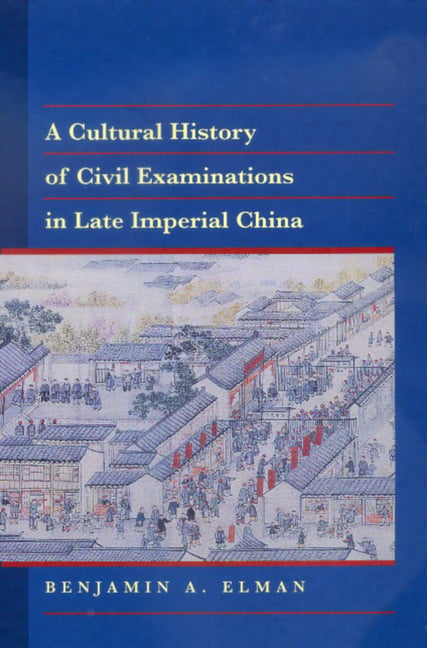
A Cultural History of Civil Examinations in Late Imperial China - Hardcover
$110.99
Quantity
01
Pay over time for orders over $35.00 with
Offers & Perks
Earn 110 points with this purchase
Added to your rewards balance after checkout.
100 points welcome bonus
Create an account and start with extra points.
Availability:In StockContributor:Benjamin A. ElmanTheme:Chronological Period/Medieval (500-1453) Studies, Chronological Period/Modern, Cultural Region/Asian, Cultural Region/ChinesePublish date:3/22/2000Pages:889
Languages:EnglishPublisher:University of California PressISBN-13:9780520215092ISBN-10:0520215095UPC:9780520215092Book Category:History, Social ScienceBook Subcategory:Asia, SociologyBook Topic:ChinaSize:9.52 x 6.03 x 2.20 inchesWeight:1.357Product ID:SC37GHZ71B
In this multidimensional analysis, Benjamin A. Elman uses over a thousand newly available examination records from the Yuan, Ming, and Ch'ing dynasties, 1315-1904, to explore the social, political, and cultural dimensions of the civil examination system, one of the most important institutions in Chinese history. For over five hundred years, the most important positions within the dynastic government were usually filled through these difficult examinations, and every other year some one to two million people from all levels of society attempted them.
Covering the late imperial system from its inception to its demise, Elman revises our previous understanding of how the system actually worked, including its political and cultural machinery, the unforeseen consequences when it was unceremoniously scrapped by modernist reformers, and its long-term historical legacy. He argues that the Ming-Ch'ing civil examinations from 1370 to 1904 represented a substantial break with T'ang-Sung dynasty literary examinations from 650 to 1250. Late imperial examinations also made "Tao Learning," Neo-Confucian learning, the dynastic orthodoxy in official life and in literati culture. The intersections between elite social life, popular culture, and religion that are also considered reveal the full scope of the examination process throughout the late empire.
Covering the late imperial system from its inception to its demise, Elman revises our previous understanding of how the system actually worked, including its political and cultural machinery, the unforeseen consequences when it was unceremoniously scrapped by modernist reformers, and its long-term historical legacy. He argues that the Ming-Ch'ing civil examinations from 1370 to 1904 represented a substantial break with T'ang-Sung dynasty literary examinations from 650 to 1250. Late imperial examinations also made "Tao Learning," Neo-Confucian learning, the dynastic orthodoxy in official life and in literati culture. The intersections between elite social life, popular culture, and religion that are also considered reveal the full scope of the examination process throughout the late empire.
Languages:EnglishPublisher:University of California PressISBN-13:9780520215092ISBN-10:0520215095UPC:9780520215092Book Category:History, Social ScienceBook Subcategory:Asia, SociologyBook Topic:ChinaSize:9.52 x 6.03 x 2.20 inchesWeight:1.357Product ID:SC37GHZ71B
Benjamin A. Elman is Professor of Chinese History and Director of the Center for Chinese Studies at the University of California, Los Angeles; from 1999 to 2001 he will be a Visiting Professor at the School of Historical Studies at the Institute for Advanced Study. He is author of Classicism, Politics, and Kinship: The Ch'ang-chou School of New Text Confucianism in Late Imperial China (California, 1990; Chinese edition, 1998) and coeditor of Education and Society in Late Imperial China, 1600-1900 (California, 1994).
Publisher: University of California Press
Contributor(s)
Author
Free shipping on orders over $75. Standard shipping takes 3-7 business days. Eligible items may be returned within 30 days of delivery. Conditions apply.