
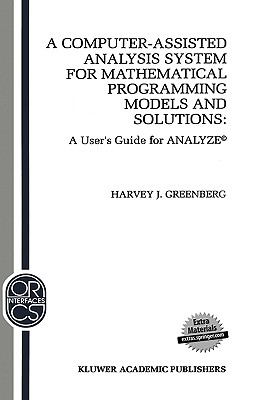
A Computer-Assisted Analysis System for Mathematical Programming Models and Solutions: A User's Guide for Analyze(c) - Hardcover
$168.99
$169.99
-1%Quantity
01
Pay over time for orders over $35.00 with
Offers & Perks
Earn 168 points with this purchase
Added to your rewards balance after checkout.
100 points welcome bonus
Create an account and start with extra points.
Availability:In StockContributor:H. J. GreenbergSeries:Operations Research/Computer Science InterfacesPublish date:3/31/1993Pages:270
Languages:EnglishPublisher:SpringerISBN-13:9780792393221ISBN-10:0792393228UPC:9780792393221Book Category:Gardening, Business & Economics, ComputersBook Subcategory:Operations Research, Computer ScienceSize:9.21 x 6.14 x 0.69 inchesWeight:0.581Product ID:SCHZBY6WX6
Welcome to ANALYZE, designed to provide computer assistance for analyzing linear programs and their solutions. Chapter 1 gives an overview of ANALYZE and how to install it. It also describes how to get started and how to obtain further documentation and help on-line. Chapter 2 reviews the forms of linear programming models and describes the syntax of a model. One of the routine, but important, functions of ANALYZE is to enable convenient access to rows and columns in the matrix by conditional delineation. Chapter 3 illustrates simple queries, like DISPLAY, LIST, and PICTURE. This chapter also introduces the SUBMAT command level to define any submatrix by an arbitrary sequence of additions, deletions and reversals. Syntactic explanations and a schema view are also illustrated. Chapter 4 goes through some elementary exercises to demonstrate computer- assisted analysis and introduce additional conventions of the ANALYZE language. Besides simple queries, it demonstrates the INTERPRT command, which automates the analysis process and gives English explanations of results. The last 2 exercises are diagnoses of elementary infeasible instances of a particular model. Chapter 5 progresses to some advanced uses of ANALYZE. The first is blocking to obtain macro views of the model and for finding embedded substructures, like a netform. The second is showing rates of substitution described by the basic equations. Then, the use of the REDUCE and BASIS commands are illustrated for a variety of applications, including solution analysis, infeasibility diagnosis, and redundancy detection.
Languages:EnglishPublisher:SpringerISBN-13:9780792393221ISBN-10:0792393228UPC:9780792393221Book Category:Gardening, Business & Economics, ComputersBook Subcategory:Operations Research, Computer ScienceSize:9.21 x 6.14 x 0.69 inchesWeight:0.581Product ID:SCHZBY6WX6
Free shipping on orders over $75. Standard shipping takes 3-7 business days. Eligible items may be returned within 30 days of delivery. Conditions apply.