
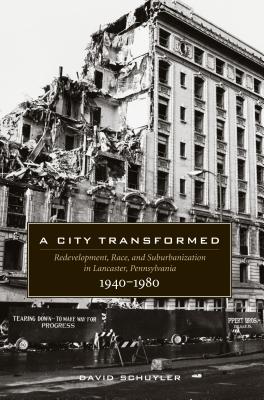
A City Transformed: Redevelopment, Race, and Suburbanization in Lancaster, Pennsylvania, 1940-1980 - Paperback
Pay over time for orders over $35.00 with
Offers & Perks
Earn 37 points with this purchase
Added to your rewards balance after checkout.
100 points welcome bonus
Create an account and start with extra points.
As was true of many American cities, Lancaster, Pennsylvania, adopted urban renewal programs in the postwar years to revitalize a downtown that was experiencing economic decline. As the commercial and residential infrastructure of the city decayed, people and jobs migrated to the suburbs. Urban renewal was supposed to make the downtown viable again as a site for both businesses and residences. But as David Schuyler shows in A City Transformed, redevelopment in Lancaster resulted in more failures than successes.
Beginning in the 1950s, the Lancaster Redevelopment Authority implemented a comprehensive revitalization program that changed the physical shape of the city. In attempting to solidify the retail functions of the traditional central business district, redevelopment dramatically altered key blocks of the downtown, replacing handsome turn-of-the-century Beaux Arts structures with modernist concrete boxes and a sterile public square. The strategy for eliminating density and blighted buildings resulted in the demolition of whole blocks of dwellings and, perhaps more importantly, destabilized Lancaster's African American community.
A City Transformed is a compelling examination of a northern city struggling with its history and the legacy of segregation. But the redevelopment projects undertaken by the city, however ambitious, could not overcome the suburban growth that continues to sprawl over the countryside or the patterns of residential segregation that define city and suburb. When the Redevelopment Authority ceased operating in 1980, its legacy was a city with a declining economy, high levels of poverty and joblessness, and an increasing concentration of racial and ethnic minorities--a city very much at risk. In important ways what happened in Lancaster was the product of federal policies and national trends. As Schuyler observes, Lancaster's experience is the nation's drama played on a local stage.
David Schuyler is Professor of American Studies at Franklin & Marshall College. He is the author of Apostle of Taste: Andrew Jackson Downing, 1815-1852 (1996) and The New Urban Landscape: The Redefinition of City Form in Nineteenth-Century America (1986). He serves on the editorial board of the Frederick Law Olmsted Papers project and is chair of the Pennsylvania State Historic Preservation Board.
Contributor(s)
Author
Free shipping on orders over $75. Standard shipping takes 3-7 business days. Eligible items may be returned within 30 days of delivery. Conditions apply.