
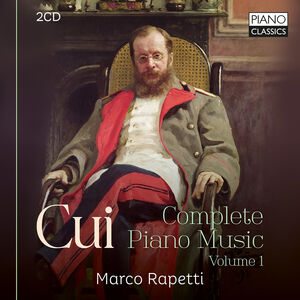
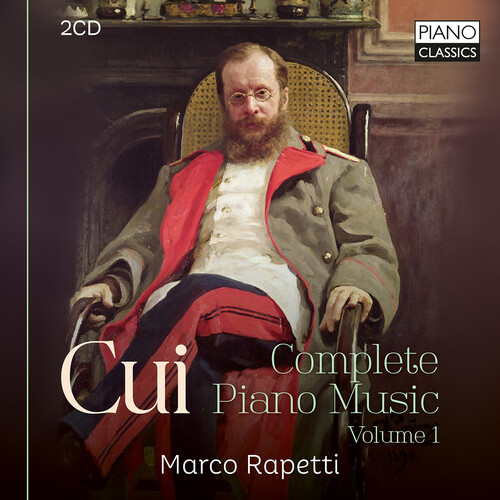
Cui: Complete Piano Music, Vol. 1 - CD
$15.99
$19.99
-20%Quantity
01
Pay over time for orders over $35.00 with
Offers & Perks
Earn 15 points with this purchase
Added to your rewards balance after checkout.
100 points welcome bonus
Create an account and start with extra points.
Availability:In StockArtist:Marco RapettiGenre:Classical ArtistsRelease date:3/13/2026Original year:2026
Publisher:Alliance EntertainmentLabel:Piano ClassicsUPC:5063758102117Weight:0.24Discs:2Product ID:SC0YE3Y9NS
First recordings of Romantic-era piano miniatures by an overlooked figure among the New Russian School of composers known as The Mighty Handful.Irretrievably forgotten, wrote musicologist Richard Taruskin of César Cui (1835-1918). Long regarded as a dilettante, Cui combined a distinguished military career-as an engineer, expert in fortifications, and Moscow professor-with prolific writing as one of Russia's most formidable music critics. He was a crucial advocate for the nationalist ideals of Glinka and Mussorgsky, even as his own music revealed a more cosmopolitan voice, steeped in the lyricism of Chopin and Schumann.In this first volume of Cui's complete piano works, pianist Marco Rapetti presents music composed between 1877 and 1888, from the Trois morceaux, Op. 8, to the Trois mouvements de valse, Op. 41. The recording includes charming sets of mazurkas and serenades, as well as two major cycles: the Suite, Op. 21-dedicated to Franz Liszt-and the Pièces caractéristiques, Op. 40, dedicated to the Count and Countess de Mercy-Argenteau, tireless champions of Cui's music in Western Europe.Rapetti, acclaimed for his rediscovery of neglected Russian piano repertoire, has previously recorded Borodin and Lyadov for Brilliant Classics. His performances, described by Fanfare magazine as showing perfect unanimity and a verve and élan that bring out all the vividness of the orchestral works, affirm his standing as a pianist uniquely suited to illuminate Cui's lyrical, poetic world.
Publisher:Alliance EntertainmentLabel:Piano ClassicsUPC:5063758102117Weight:0.24Discs:2Product ID:SC0YE3Y9NS
Publisher: Alliance Entertainment
Label: Piano Classics
Artist(s)
Free shipping on orders over $75. Standard shipping takes 3-7 business days. Eligible items may be returned within 30 days of delivery. Conditions apply.